Showing posts with label fantasy. Show all posts

Friday, July 1, 2016

Launch Day! BEYOND RAINBOW: 6 Tales of the Fantastical #fantasy #shortstories


I'm delighted to present Beyond Rainbow: 6 Tales of the Fantastical, my latest e-book collection for adults.

From neo-folklore to urban fantasy, from ancient villages to modern suburbs, award-winning author Anne E. Johnson explores a wide range of fantastical fiction in this collection.

A man becomes fascinated by a child who saves lives in Connecticut; two sibling gemstones compete for the attention of the humans who use them for magic; an institutionalized patient hears hostile beings in the radiator...


These six little stories will by turns disturb, challenge, and mesmerize you.


You can purchase Beyond Rainbow at

Amazon    Barnes&Noble     Kobo     iTunes

and elsewhere, for the crazy-low price of 99 cents. Enjoy. And please remember to leave a review.

Thanks.

-Anne

Monday, June 13, 2016

Upcoming reading in NYC: Rough&Ready Chapter One (novel openings) @RoughnReadyRep


I'll be there, reading from a middle-grade fantasy novel. (The "rough" means works-in-progress.) These Rough & Ready events are always great fun!


Thursday, May 19, 2016

Thursday, May 12, 2016

J.L. Gribble's Adventures in Outlining Her Novel STEEL VICTORY


In March I had the pleasure of being a guest author at Cleveland ConCoction. On the last day of the con, as I sat in the book room, I started a conversation with my neighbor. J.L. Gribble was selling her novel Steel Victory, the first in her Steel Empires series for Dog Star Books. She kindly agreed to stop by Jester Harley's Manuscript Page to tell us her outlining secrets. Listen up!

*   *   *

Adventures in Outlining
By J.L. Gribble

Though I didn’t write my debut novel, Steel Victory, with the intention of turning it into a series, I jumped at the chance to do so at the invitation of my publisher. Unfortunately, that means actually writing the series! After a brief moment of panic, I got into the swing of things and committed to publishing a novel a year for what is now known as the Steel Empire series. While Steel Victory was published in summer of 2015, and its sequel, Steel Magic, is set to be released this upcoming July, I’ve also already completed a full draft of book 3 and a full scene-by-scene outline of book 4.

Writing a book is pretty much, well, writing a book, but one part of the process I’ve managed to do completely differently every single time is the outline stage. Two terms often used for writers are those who are “plotters” (who have the entire story down before they begin the first draft) and “pantsers” (who make everything up as they go along). Time to do some compare and contrast!

Book 1
Steel Victory was written during the course of a two-year graduate program. I knew what sort of book I wanted to write—urban fantasy, alternate history, nontraditional vampires, strong family bonds—but the actual plot was a different matter. I knew where I was going a few scenes in advance, but once I wrote those few scenes, it was back to square one until I came up with what happened next. This is pretty much the definition of pantsing.

Pros
It is very easy to switch directions using this method because you’re not locked into anything if genius strikes while you’re out for a walk or driving somewhere. Or in my case, in the shower.

Cons
I had a ton of clean-up work to do on the book afterward. Some scenes needed to be restructured and I ended up cutting over 10k words from the final version because a few more scenes were ultimately useless because I hadn’t quite nailed down where I was going at that point.

Book 2
Because I was on more of a time crunch to draft and revise my second novel (one year versus two), I knew that I needed to find a better method. For Steel Magic, I started with a full road map (the plotter method). Before I wrote one word of the novel, I had almost 5k words of a detailed outline. I knew what was going to happen in every scene, down to the locations and minor characters involved.

Pros
There was never a break in the action. This was especially helpful during NaNoWriMo (National Novel Writing Month), when I wrote a full 50k words of the novel in 30 days. I never had to sit back and wonder what was going to happen next.

Cons
Sometimes I did come up with a few tweaks or a better way to handle the story, and when that happened, I had to go back to my outline and make sure I wasn’t going to write myself into a corner or cause any major plot holes down the line.

Book 3
With another book to write in a single year, I knew I had to stay with the full plotting method. This book I switched it up once again, because I had set myself the goal of a traditional Romeo & Juliet plot (with bonus feminism) set in my world, with my characters. So my scene-by-scene outline was a direct scene-by-scene retelling of Shakespeare’s play. As a former English major, this was both a challenge and a blast.

Pros
Because I was basing my story on such a classic tale, I had a blast figuring out my twist on it. It’s not that most of the work was done for me, especially considering my version has a few more epic battles between weredragons and vampires, but having a solid jumping off point certainly made things a bit easier.

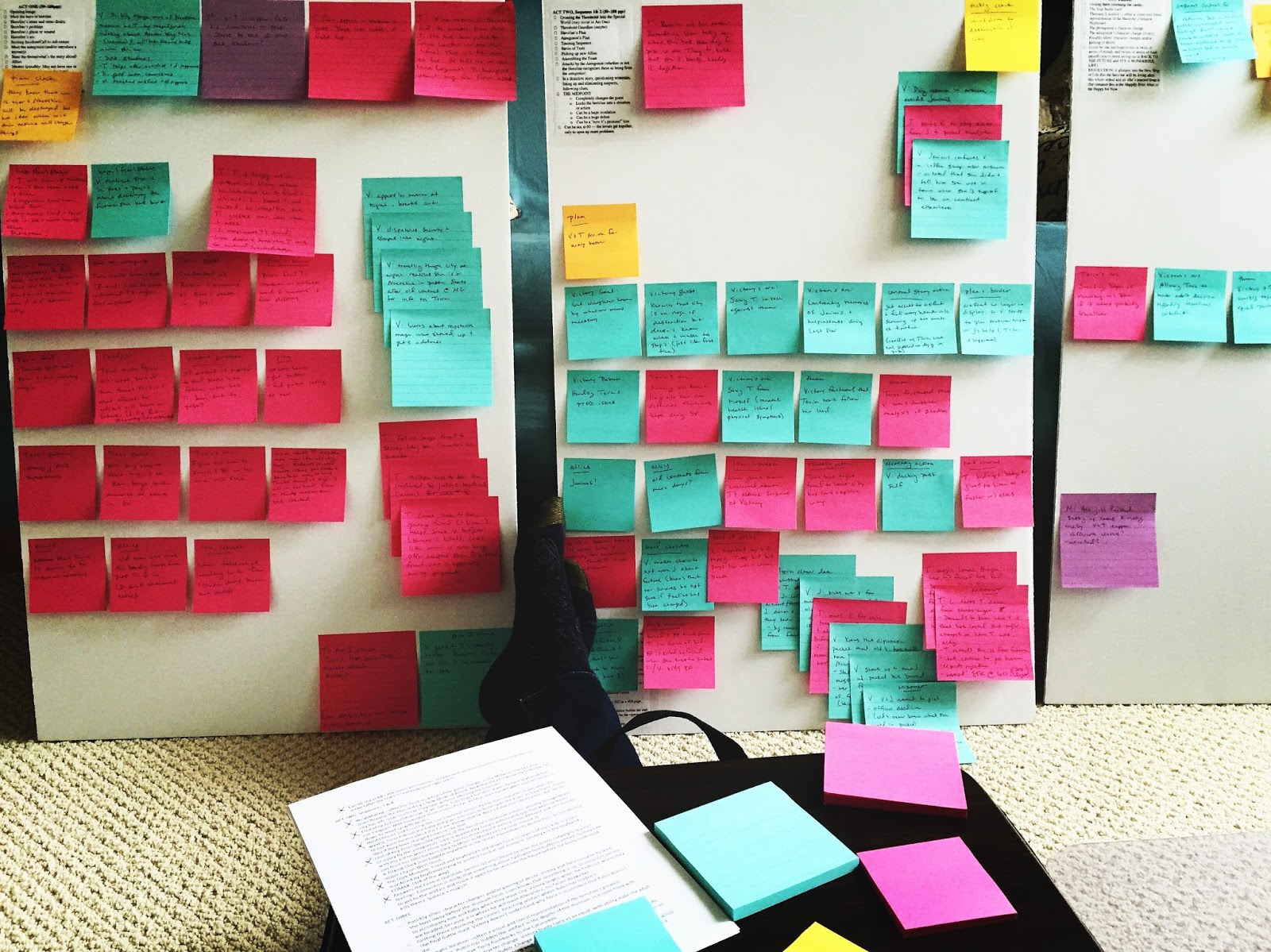
Outlining book 4 using the Three Act Structure template.
Cons
The narrative structure of a stage play written hundreds of years ago is a tad different from a popular fiction novel of today. I have many more major revisions still in progress for this book based on some critiques from beta readers, in which some scenes need more conflict and at least one needs to be cut completely.

Book 4
At a writing retreat a few months ago, I learned about another outline method called the Three Act Structure used in conjunction with lots of note cards. (For more information on Three Act Structure, click here.) I decided to use this one for my latest book, which involved figuring out all of the major themes and plot points and then filling them out into individual scenes. For me, this involved lots of colorful post-it notes and poster board in for office for my cats to knock over.

Pros
The template provides a great list of things that should be included in a novel, like character goals and the dark moment before the act. This was a helpful guide for really digging into the meat of the story I was trying to tell.

Cons
I ended up with a lot of major events and nothing in between. Figuring out the smaller conflicts while maintaining a good pace was more difficult than I expected it to be.

What I Learned
This is probably where you expect me to tell you what the best method is, right? Absolutely not. One of my favorite things about the art of writing is that there is no one, true way. Through trial and error, I’ve learned which way works the best for me. The book 2 method: organically outlining in chronological order, by the way. Since I’m not planning anymore rewrites of long-dead playwrights, I think I’ll stick with this for the rest of the series. And to be honest, when I read other novels, I can almost never tell what sort of method the author started out with anyway!

The last few years have been an adventure, but now that I’ve found what works for me, I can’t wait to jump into future projects. After I actually write book 4, of course.

*   *   *

Learn more about J.L. Gribble on her website, Facebook, and on Twitter/Instagram @hannaedits.

Purchase Steel Victory on Amazon.


Sunday, November 1, 2015

Want great #scifi and #fantasy for cheap? Check out #99centNovember


Happy Fall! You know what's falling besides leaves? The price of some great speculative fiction during a special promotion called #99centNovember.

It's Cyber Monday all month long! 

Such an honor that all the e-book formats of Things From Other Worlds are part of this celebration. I'm in very distinguished company, including Milo James Fowler, Daniel AusemaJames Garcia Jr., Simon KewinMichelle Ann KingTB MarkinsonTyrean MartinsonRhonda Parrish, and Loni Townsend.

Get all the juicy details here.


Thursday, October 8, 2015

It's Launch Day for #kidlit #scifi #stories THINGS FROM OTHER WORLDS


Hey, Hey and Happy Day!

Today I am pleased as pink bubbly to announce the launch of my book

THINGS FROM OTHER WORLDS
15 Alien and Fantasy Stories for Kids

"Enchanting!" -Ellie Ann, New York Times bestseller

Many strange things wait inside these pages. There's a fuzzy ball of kindness, camped out on a grumpy man's porch. A chewed piece of gum with a mind of its own. A smart Alec who actually stands in line twice when they're handing out brains. A girl who isn't afraid when all the plants in her neighborhood come to life.


This collection of 15 science fiction and fantasy stories for kids by award-winning author Anne E. Johnson is perfect for ages 8-12, or anyone with a child's heart.


Things from Other Worlds is available as both print and ebook. Here are some of the places you can find it:


If you'd like a signed copy, here's what you do:

1. Attend one of my live events (details to be posted soon here, on my website, and on Goodreads).
2. Email me at Contact@AnneEJohnson.com to ask about buying the print book directly from me or requesting a signed book plate.

Thursday, August 6, 2015

Unexpected Time Travel to Ancient Egypt in Vanessa MacLellan's THREE GREAT LIES


One of my favorite new markets for speculative fiction is the Dreaming Robot Press series Young Explorer's Adventure Guide. I was honored to share the 2015 table of contents with Vanessa MacLellan, and I'm further honored to have Vanessa as a guest today to discuss her new novel, Three Great Lies.

*   *   *

When I was little I had three great fascinations: Dinosaurs, terraforming other planets, and Egyptian mythology. Sit for a moment and remember the focus you had as kids, when all you wanted to do was play ball, or teach your dog to fetch, or read about space aliens? Well, for me, those three were tops. I had plastic dinosaurs I'd play with in the mud; they built towns and had a government. Read sci-fi where human colonists turned desert landscapes into rolling fields. And I had this great picture book with pyramids and pharaohs and mummies in it, along with a description of what each god meant.

I've been fascinated ever since. So, back in 2008 when I was preparing for my fifth NaNoWriMo challenge, I began to ponder... how well would I survive in an ancient world, like, say ancient Egypt?

Thus the seed was planted and much research was tackled.

A major aspect of the book (the stray dog theme) sprang to life at an agility dog show. The midsummer day was baking hot and I had parked myself under a tree for the next show. A Jack Russell Terrier was looking at me with that intelligent tongue-lolling smile terriers have. Honestly, the dog was smiling.

And that was the original start of the novel: "The dog was smiling at her." It's since changed, but that line and scene are still in there, the theme planted throughout the novel. The story just unfolded from that one dog's smile. I thank the heavens for smiling dogs!

After that, sitting in the hot sun, I began writing long hand. Then moved the novel to my computer and it flowed from there. I wrote 50,000 words of a woman fumbling her way through ancient Egypt, being chased by mummies, crocodiles and slave masters. Of her using her vast knowledge from spy movies to infiltrate a spy ring and help a young woman find her purpose and a mummy find his soul. It was a good ride.

It is still a good ride. One that's just starting.

Blurb for Three Great Lies:

While vacationing in Egypt. . .
Jeannette Walker, a cynical scientist jaded by swarms of tour groups and knick-knack shacks, is lured by a teenage tour guide to visit a newly discovered tomb. No other tourists there! Inside the chamber, she tumbles down a shaft and 3000 years back in time.

Now, in a world where deities walk the streets and prophecy stinks up the air, Jeannette is desperate for normal and the simple pleasures of sanitation and refrigeration. However, a slave master hawking a cat-headed girl derails her homebound mission, and Jeannette—penniless in this ancient world—steals the girl, bringing down the tireless fury of the slaver.

Saddled with a newly awakened mummy and the cat-headed girl, Jeannette, through her unparalleled experience gained from watching spy movies, contrives a plan to free them from the slaver's ire, but will she have to dive into the belly of the beast to succeed?


*   *   *
Follow Vanessa MacLellan on her websiteFacebook, and Google+.

You can purchase Three Great Lies on Amazon

Thursday, July 30, 2015

Pat McDermott continues her #YAlit GLIMMER series about Irish fairies


Always a pleasure to welcome back Pat McDermott. If you're intrigued by ancient Ireland and fairies, you do not want to miss her books!

*   *   *

Blending Folk Tales, Boosting Glimmer
by Pat McDermott

When I started writing my young adult adventure series featuring Ireland’s fairies, I knew that at some point, I’d be dealing with leprechauns. They appeared at last in the third Glimmer book, A Pot of Glimmer. How to describe these famous sprites without making them sound like the run-of-the-mill gremlins on cereal boxes and in tourism ads proved challenging.

A Pot of Glimmer opens in medieval Ireland, 1014 AD, just before the historic Battle of Clontarf in which High King Brian Boru defeated the Vikings. My patriotic commando leprechauns, led by one Awley O’Hay, rob a Dublin mint to provide silver coinage for King Brian’s troops. The theft leaves Steng the Money Master a tad annoyed with Awley.

“Irlander insect! I will hunt you down and find you! I will burn out your thieving eyes and leave your corpse for the crows to devour!

Awley isn’t worried. How can a mere Norseman capture a leprechaun?

“You and your kind couldn’t catch the plague! King Brian will send yez back where yez came from!

The unfairness of Awley wielding his magical glimmer while Steng lacked a comparable gift compelled me to even the playing field. My investigation into Viking mythology offered a fabulous way for the money master to take his revenge. From past research, I knew a good deal about Vikings, but I’d never heard of a draugr, an undead creature who leaves its grave at night to feed on men and cattle. Awley finds himself in serious trouble each time the money master-turned-draugr turns up to haunt him. There’s little he can do, however, for draugrs can only be slain by mortals. Yet he’s not without resources. More than once, he’s turned to Becula, a powerful fairy witch, for assistance.

“’Tis fine to see you, ma’am. I find I’m again in need of your help. Your latest Draugr Confinement Spell has kept the essence of Steng beneath the ground for two hundred years. He’d no doubt be there forever, but for the Yank ambassador.”

“The American ambassador? Ambassador Gleason?”

“You know him?”

“I do. His young granddaughter is a friend of mine.” Becula narrowed her eyes. “’Twould displease me if anyone tried to harm her. What’s this all about?”

“The ambassador’s hired diggin’ machines. I don’t know why, but those gizmos are pokin’ too close to the stone we set over Steng’s coffin box. If they disturb it before we can move him to a safer place…”

Awley’s dilemma casts American teen Janet Gleason and her royal friend, Prince Liam Boru, into a web of unthinkable horror. In the first two Glimmer books, Janet and Liam’s budding romance suffers from fairy mischief, but fighting a draugr together takes the cake.

“Are you saying there’s a dead Viking monster buried in my grandfather’s putting green?”

Liam and his royal clan are descendants of High King Brian Boru. Liam’s lineage impresses the leprechauns, yet he has no time for formality: the draugr has kidnapped Janet.

“We have to do something. Draugrs eat mortals, and my friend is a mortal!

Melding elements of two unique oral traditions entertained me enormously as I wrote. The characters seemed to dictate to me, guiding me through their struggles with danger and romance (leprechauns fall in love too). These classic story ingredients, commonly found in the folklore of every culture, gave the world its first great sagas. May folk tales ever inspire us!


Blurb:
Ireland, 1014 - Leprechaun Awley O’Hay robs a Dublin mint to help King Brian fight the Vikings. The money master’s vengeful ghost troubles Awley for centuries.

Ireland, 2015 - The fairies have not only plagued American teen Janet Gleason since she arrived in Dublin, they’ve also hindered her romance with Prince Liam Boru. When Janet’s grandfather, the American Ambassador, throws a Fourth of July celebration, Liam stops by. Also attending are several uninvited guests whose appearance plunges Liam and Janet into a nightmare they never imagined. Nor did they imagine that real leprechauns are nothing like the “little men” of Irish lore.

*   *  *
A Pot of Glimmer, Book Three in the Glimmer Series, is available in print and eBook from Amazon.


Learn more about Pat and her books on her website.

Thursday, July 23, 2015

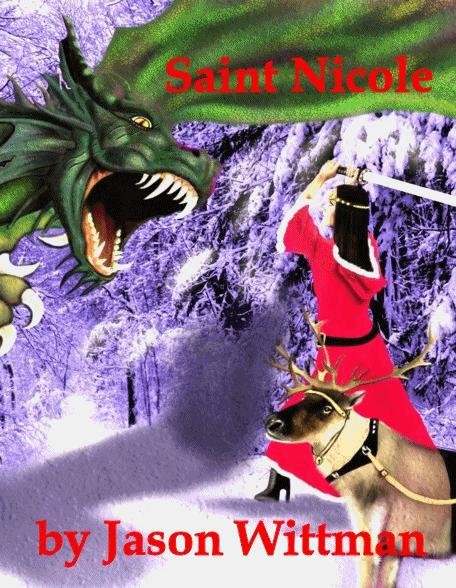
Santa's Daughter as Dragon Slayer: Jason D. Wittman's SAINT NICOLE


I'm delighted to welcome fellow Alban Lake Publishing author, Jason D. Wittman, who promises to give some insight into his highly original fantasy novel, Saint Nicole. Christmas in July, anyone?

*   *   *
Twisting the Roots of Christmas 
by Jason D. Wittman

When Anne invited me to discuss my novella Saint Nicole on her blog, I was not sure what to write at first.  Most writers grow uncomfortable when asked, "Where do you get the ideas for your stories?"
 
The reason for this is that the people who ask that question seem to expect some fascinating, eye-opening answer, like: "I was playing Nikolai Rimsky-Korsakov's Flight of the Bumblebee on my bagpipes one day, when suddenly it occurred to me..."  In reality, most sources of inspiration are depressingly ordinary.  Stephen R. Donaldson, for instance, has famously said he was once inspired by a can of Lysol disinfectant in a men's room at a convenience store.
 
Me, I get my inspirations from other sources.  One time, some co-workers and I were discussing funny t-shirts we had seen, and I told them of one that said "Schrodinger's cat is dead," on the front and "Schrodinger's cat is not dead," on the back.  My co-workers all gave me blank stares.  And as I struggled to think of a way to explain the concept of Schrodinger's cat to them, my short story The Sarcophagus of Lady Schrodinger was born.
 
The inspiration for Saint Nicole, though, did not come from a t-shirt.  It came from those newspaper articles you see whenever Christmastime rolls around that tell of how the various Christmas traditions came to be -- the Christmas tree, for instance, comes from Germany; while mistletoe was originally used in druidic rituals.  This got me pulling together a mythical "origin story" of how all these ancient traditions joined forces to become what we know now as Christmas.  And that phrase "joined forces" put me in mind of an epic conflict, where the peoples of various cultures come together to defeat a common enemy, in the vein of The Lord of the Rings.  There would be mortal human beings, of course, and joining them would be the Fair Folk, as well as the Thunder People, vaguely representing the Norse, and the Lightning People, representing the Greeks.  I also put in a mysterious figure called the Silent Knight, and the Five Golden Rings, powerful magic talsimans inspired by The Lord of the Rings and the old song "The Twelve Days of Christmas."
 
Santa Claus, or St. Nicholas, would have to be involved, of course.  Eventually, I got the idea of there not being one, but generations of them, each inheriting the role from his father when the time came.  And this inspired a further twist: what if a Nicholas died without any male heir?  What if he only had a daughter?  And so our heroine Nicole was born, who finds herself assuming her father's mantle when he is killed by his ancient archenemy...
 
Archenemy.  Let's see now.  What kind of archenemy would be appropriate for this story?  Well, since Christmas is all about the bestowing of gifts, and of Peace on Earth, Good Will to All, it seemed to me that the story's main antagonist would have to be the most sociopathic, solipsistic creature ever born.  And so I came up with the dragon Furnaceheart, whose one single goal in existence is to eat everything and everyone in existence.  Throughout the entire novella, he cannot understand why all this yummy food does not want to be eaten.  Don't they understand that's what food is for?  I wrote an entire chapter of the novella from Furnaceheart's point of view, and it was extremely fun to write an interior monologue with that kind of mindset. I like to think I got it right.
 

In the end, it falls to the young, inexperienced Nicole to defeat this vile foe.  If you want to know how she fares, you will have to read the novella itself.

*   *   *
Learn more about Jason D. Wittman on his blog.

Purchase Saint Nicole from Alban Lake Publishing.


Thursday, April 30, 2015

Sandra Ulbrich Almazan on bringing #Beatles #magic to her #fantasy novel, SCATTERED SEASONS


Creating complementary main characters is a skill which, if mastered, can lead to great fiction. Today Sandra Ulbrich Almazan explains how she developed the women in her new novel, Scattered Seasons.

*   *   *

From the Fab Four to the Fem Four:
Designing a Quartet of Characters
by Sandra Ulbrich Almazan


It happened nearly twenty years ago, while I was reading Mark Hertsgaard’s A Day in the Life: The Music and Artistry of the Beatles. I read a description of the Beatles’ four-fold synergy and thought I’d like to write a story about a quartet working together to create literal magic. From that idea, I slowly came up with a group of four women who each had a type of magic associated with a different season. They were originally called Season Lords, but I changed their name to Season Avatars for a gender-neutral term.

While the magic concept was important, even more important was creating a group of characters with different but complementary personalities. There are different tropes for doing this, such as the Four Element Ensemble, the Four Temperament Ensemble, or even using blood types.  (Warning: all these links lead to the fun but time-sucking TV Tropes website.) I chose a simpler method, which I’ll refer to as “Brain-Body-Heart-Soul.”  This was also inspired by a description of the Beatles. (Fans may disagree on who played what role within the group. I see John as the brain, Paul as the body, George as the soul, and Ringo as the heart.) Each of the four Season Avatars plays one of these roles within the group.

Gwendolyn, the Spring Avatar, is also the leader of the group. Her job is to heal people and coordinate the magic shared by the Avatars so they can perform tasks togethers. As a noblewoman, she’s had the most formal education of the four, so she’s the “brain.”

Jenna is the Summer Avatar and has plant magic. She’s the most sensual of the quartet (so she’s the “body”) and frequently has to remind Gwen to have fun and not focus constantly on her duties.

Ysabel, the Fall Avatar, has animal magic. As the heart of the group, she’s friendly and warm. She’s a diplomat who wants everyone to get along and will mediate when the others argue among themselves. Gwen and Jenna tend to argue a lot, so sometimes they need a go-between.

Finally, Kay, the Winter Avatar with weather magic, is the soul of the group. Although all of the Avatars originally obtained their magic from the God or Goddess associated with their season, she is the most pious and the least likely to question her God’s will.

Of course, it wouldn’t be satisfying to make each character one-dimensional, a person fit only for a certain role and no more. Each of the Avatars comes from a different type of family and a different background. Some of them have talents in non-magical areas, such as music, drawing, or sewing. They all have different personal challenges to overcome as they learn to work together. Each of them will get her own book, starting with Gwen in Scattered Seasons, to tell her part of the overall story.

I look forward to introducing them to you.

*   *   *
Learn more about Sandra Ulbrich Almazan on her blog or on Facebook.

Purchase Scattered Seasons on Amazon and Barnes & Noble.

Thursday, February 26, 2015

#Writer & #artist Laura Wilbourn takes us on a #picturebook journey with Asterion's Elixer

When I met Laura Wilbourn at a SCBWI conference a few years back, I was immediately struck, not just by her intelligence and humor, but by the unusual, etherial quality of the picture book she had brought to show everyone she met. When I learned that she was about to publish a new book, Asterion's Elixir, I jumped to invite her to join us here and talk about her process. And look at these wonderful illustrations, which Laura does herself!

*   *   *

Creating Asterion's Elixir
by Laura Wilbourn

I have always been a fan of imagination. As far back as I can remember, daydreaming has taken precedence over anything that required academic attention. In one recurring daydream that I recall vividly, I had the ability to magically transform myself into a flying unicorn. At the time, I was in first grade at the International School of Bangkok, and in this fantasy, the classroom was on fire. I transformed into a mystical creature that flew through the window and saved my class from the flames. Even though it occurred at such a young age, I feel this daydream was very telling of who I would become as a person and planted a seed from which my children’s books would originate. 

In second grade, my family and I moved back to California. With the option of choosing my own wallpaper for my room, of course I chose unicorns. Between the daydreams and the wallpaper, it may not come as a surprise that my children’s book, Asterion’s Elixir, includes a unicorn! 

Not only is there a unicorn, but a lot of color as well! My ultimate favorite color is blue (with red a very close second). What better place than space to fulfill this color scheme? An interesting fact about another influence in my life at the time I was writing this book: I was taking an astronomy class at Texas State about the stars and galaxies. Reading all that material and seeing all those pictures definitely sparked my mind's adventure into the unknown. This book is unique in that it contains many bright and engaging colored images, but there is an abundance of text as well. This is exactly what I wished for as a ten-year-old girl. I was never satisfied with the illustration-text ratio. It was either a lot of text and few pictures, or it was very little text and so many pictures. How do you solve this dilemma? Make your own children’s book! Make it exactly how you wanted it as a child, so that every part of the inner-child in you is fulfilled. 

Though the influences of this story are easy to distinguish, my process is harder to explain. I don’t have a clear-cut path when I create a book. I do both the writing and the sketching at the same time. However, what is consistent is that the seed of a story begins with a drawing that eventually blossoms into character development. From here, a few more sketches are made which make room for plot development. It is a back and forth movement between the graphic and the literary art, and somehow I end up with a book and illustrations in the end. 

*   *   *
Learn more about Laura Wilbourn and purchase Asterion's Elixir on her website. Follow her on Facebook.

Thursday, December 4, 2014

Alma Alexander on RANDOM and what it means to be human

Today's guest, Alma Alexander, writes fantasy. She explains how she sees the imaginative world of her fiction as standing for the complexities of everyday life.

*   *   *
The World of Random
by Alma Alexander


When a new book comes out, it's  always fascinating to see just what
it is that jumps out at people, what readers take away from it, how
they respond to the things the writer believed important enough to
build into the story.

In reviews of my latest book, "Random",  I was very happy to see
readers and reviewers pick up on the things which had mattered to me,
which I had put in there for a reason and a purpose, and which were
finding their mark - things like how I had portrayed issues like
bullying and discrimination, what it felt like to be an immigrant in a
strange new place, what it felt like to live "different" and how it
affected the minutiae of one's life.

I was very happy to see comments like "this is a book on what it means
to be HUMAN" - because that, wrapped in the fantasy world inhabited by
the Were-creatures I had created to live there, was exactly what I had
been aiming for.

Being human is such a complicated thing, almost impossible to
communicate precisely from one human mind to another; we may share the
commonality of form and function, but our inner lives are all very
different. We look at the world as filtered by those different
experiences and expectations and often find it disconcerting to have
that worldview challenged by somebody else who might look at an
identical thing but perceive it very differently because of their own
set of filters.

But here's where fiction - fantasy, in particular - is such a
magnificent and unifying lens through which it is possible to look at
something we would find it tough to focus on in its raw reality and to
suddenly perceive the object we are observing and judging in a very
new light.

In fiction, you are offered a set of filters which are almost
inevitably very different from your own - and through those filters,
with a helping of empathy and insight, you are permitted to see
something with a whole new set of eyes.

What I wanted to put out there is that very question - that
deceptively simple question - what DOES it mean to be human, what does
it mean when I consider myself human, and how can I possibly take it
upon myself to judge another human by standards that apply only to me
(because they can't help but fail that test; nobody else can BE me, by
definition).

If readers close this book with that in their minds - if they steal a
glance across the aisle and see someone who is not quite like them (a
different race, a different creed, a different sexuality) and see a
connection which had not been there before - even if only a bare
handful of readers do this - we have a beginning of something
potentially wonderful. We have the potential to talk to one another,
to bridge the chasms between us, to communicate, to understand.

And my Were-kind will have left a solid and valuable legacy.


*   *   *

Learn more about Alma Alexander on her website and on Facebook.

Purchase Random on Amazon. Read some reviews on Goodreads.


Thursday, October 23, 2014

Andrea Buginsky Considers the Future for the Girls of New Avalon

The magical and the exotic are wonderful elements to add to fiction. However, their sparkly presence is no excuse to ignore the basic techniques of writing that can make stories great. Andrea Buginsky discusses the importance of character development in her YA fantasy series, New Avalon.


*   *   *
Character Growth

by Andrea Buginsky

I have always loved King Arthur stories. When I saw the movie The Mists of Avalon on TNT several years
ago, I loved the way the writer retold the story of the ladies of Avalon. One of my favorite Arthurian characters is the Lady of the Lake. So, when I was choosing a subject for my first (and last) NaNoWriMo (National Novel Writing Month), I decided to create my own story about Avalon and the Lady of the Lake.

I knew I wanted the story to take place in modern times, and I knew I wanted to use magic. The logical choice was to make my characters witch-like. Then I got the idea to write about an introverted character who never seemed to fit in at her school. But once she finds out the truth about herself and is sent off to a special school with other girls like her, she blossoms. This is where New Avalon comes from.

I was always a very introverted person, until I got to know people, then I would come out of my shell. I never had a large circle of friends, but the small circle I had was very tight. I’m still in touch with many of them today. When I created the characters for New Avalon, I had this idea in mind: a group of girls who would form life-long friendships. I knew they would be facing many ups and downs throughout the series, and I wanted them to be there for each other as they went through them.

The first character I created was Elena, the introvert. When you meet her, you’ll understand why she’s so shy around her classmates. I enjoyed watching Elena grow in Destiny, and continue to grow in Fate. There’s more to come for her in future books of the series, and she will discover many layers of herself. She will need her friends to help her get through her obstacles. But they will also need her.

My plan for the books is to focus on one girl per book so readers can get to know each of them better. In Fate, you’ll discover there’s more to Izzy than meets the eye, and suddenly, Elena will have to be there for her, which continues to help her grow. The other girls are always there too, allowing all of them to be together through thick and thin. I’m enjoying getting to know the girls as the series grows, and watching them grow along with it.


*   *   *
Learn more about Andrea Buginsky on her website.
Purchase Destiny and Fate (the New Avalon series) on Amazon and Barnes & Noble.

Thursday, October 9, 2014

J.R. Sparlin's Irish Saga, The Sea at Mughain

Sometimes a journey can open the floodgates of a writer's mind. When J.R. Sparlin visited Ireland, a new saga was born from the ancient past. With the help of a lot of fascinating research, she turned her impressions of the Celtic surroundings into her YA historical fantasy novella, The Sea at Mughain.

*   *   * 
Threads
by J.R. Sparlin

When my husband and I visited Ireland, the first thing we saw was a big sign that read, “If you think this is all there is to Ireland, you’re wrong.” A toy leprechaun was stabbed onto it with a knife.

Many threads came together to give me the idea for The Sea at Mughain. Ireland was not at all what I expected. I had not, of course, expected leprechauns. But it is an ancient, remote, eerie place, full of sun-dappled green valleys, sheep, and the ruins of castles, churches, and ancient monuments no one really understands. It is also a modern country, with all the challenges faced by any of the rest of us.

The people of Ireland are anything but remote; we had wonderful conversations with our B&B proprietors and others we met along the way. One of the places we stayed was a renovated nineteenth-century schoolhouse in Ballinskelligs, just out of sight of the sea, an area believed by the ancient Celts to be an “in-between place” between our world and the Otherworld.  I sat by a peat fire in the sitting room and watched a wave of opaque white fog, several feet high, roll in over the hills that hid the sea. No getting around it, it was strange.

At some point after our trip, I was sick and had nothing to read. My husband has a degree in ancient and medieval history and has accumulated an extensive library. I snuffled around and found a volume entitled Ireland before the Vikings. I greatly enjoyed reading it. I especially liked a remark, early in the book, to the effect of, “This was a very long time ago and we have very little evidence so this may or may not be right.” Now that just begs for stuff to be made up. Derek was horrified to find me reading it; it is very scholarly and I was very sick and he felt I should be reading something lighter, so he went out and bought me two movie-star magazines. (I read those as well.) But the damage was done. I read another book, How the Irish Saved Civilization by Thomas Cahill, and was intrigued by the way Christianity had spread in Ireland. It was a much more peaceful process than in the rest of Europe, but it was still a period of conflict and transition between the old and new ways, and that type of transitional period, to me, just begs for stories.

I learned, as well, that a branch of my mother’s family may be descended from Dal Riata, one of the ancient kingdoms of Ireland (roughly equivalent to today’s County Antrim). This may or may not be true, but it is fun to consider.

So these were probably the main threads. Here you have a highly developed heroic culture in sixth-century Ireland, and most of the history and stories of the period deal with kings and battles and so on. I was interested in how a relatively unimportant young woman would fit into this picture, and that is how Mughain, daughter of Tiernan, king of Dal nAraide, came to be. If this were a “real” Irish saga, it would likely be about her father, not her. There is no shortage of strong female characters in the old stories, but they are in positions of more prominence.

So the story wove itself around these threads, and banged around in my skull until I wrote it down, and I present it to you, and hope I have done some justice to its strangeness and beauty.


*   *   *
Learn more about J.R. Sparlin by visiting her blog or following her on Facebook.

You can purchase The Sea at Mughain on Amazon and Barnes & Noble.


Thursday, September 25, 2014

In her YA novel ELIXIR BOUND, Katie L. Carroll has personal ties to the female characters

I'm delighted to be participating in the blog tour for author Katie L. Carroll's YA fantasy novel Elixir Bound. Katie shares some background on the extraordinary women in this story.

*   *   *

The Women of ELIXIR BOUND
By Katie L. Carroll

I originally conceived ELIXIR BOUND as a there-and-back-again quest, a sort of tribute to my sister

Kylene, who died at the age of 16. I had hoped to give her a fantasy tale of her own. When it proved too hard to write the story from the POV of a character inspired by her, I decided to try from a different character's POV: her sister Katora's.

This really changed the direction of the story. Where Kylene was sweet, sensitive, and wore her feelings on her sleeve, Katora was stubborn, independent, and also sensitive but would never want to show it. ELIXIR BOUND then became a story about a young woman (Katora) who must go on a quest to find out whether or not she will become guardian to a secret healing Elixir and bind herself to it.

The binding part was key because it wouldn't allow to just use the Elixir as she wanted to; the binding would force her to use it in a way that also served the Great Mother (who is also called Mother Nature, and is basically the highest form of being in Katora's world). Now I had a story where a very independent character was forced to make a decision that would seriously hinder her independence and impact the path the rest of her life would take.

This whole story line was a personal journey that was paralleled by a physical journey in which Katora and her companions had to find the secret ingredient for the Elixir. Notice the total lack of mention of a love interest. It was really important to me that Katora's motives for the quest had nothing to do with a boy.

It was also important that Katora be chosen for this quest, not either of her two older sisters or her younger brother. I've always wondered why in so many real and fictional worlds the oldest son is the one who is entitled to the inheritance, so I wanted Katora to be neither the oldest nor a boy. The reason Katora was chosen as the next guardian of the Elixir, taking over for her father, was she was person who was best suited for the job.

As I started writing ELIXIR BOUND, I realized I wanted these themes to be reflected in Katora's world as well. I think a lot of these themes spilled out of me unconsciously and only in revision did I become consciously aware of the feminism in them. Suddenly Katora's world had turned very pagan with the people following a female deity (the Great Mother) closely tied to nature. From there I sort of ran with the idea that females would, in a sense, rule this world. Though I kept it that Katora would take over for her father because I wanted some balance in the world. Women didn't need to rule everything.

And Kylene was still there on the quest and plays an important role (though not the starring one). I wanted her there to contrast Katora's personality because there are other strong female characters besides the bulldozer type, which is kind of how I think of Katora. I needed a female who was strong in character but not in your face about it. Also, Zelenka, a member of the miniature demick species, was an interesting female character. In many ways very much like Katora, but also a bit of an adversary to Katora. They never quite get along, mostly because they are so alike.

There does end up being a love interest on the quest. One I had to emphasize and play up more as I went through revisions because several of my early readers didn't think it played a big enough role. Katora initially resists forming a relationship with Hirsten, the handsome son of a famous mapmaker. She doesn't want anything to distract her while on her mission and while she has such an important decision to make.  Though the quest part of the story is not driven by romance, Katora's ability to realize her capacity for love (and in turn why she has resisted her feelings for Hirsten) does play into her decision on whether or not to become guardian of the Elixir.

As you can see, I thought a lot about the role of females in the made-up world of ELIXIR BOUND as I was writing it. I'd like to think my story offers a feministic look at females and hopefully speaks to teenage girls in a positive way. Although, I didn't want to force any certain didactic message about feminism in the story...more an offering of female characters and how they take control of their lives and futures. Themes I certainly plan on considering while writing future works as well.

ELIXIR BOUND
YA fantasy
by Katie L. Carroll

Katora Kase is next in line to take over as guardian to a secret and powerful healing Elixir. Now she must journey into the wilds of Faway Forest to find the ingredient that gives the Elixir its potency. Even though she has her sister and brother, an old family friend, and the handsome son of a mapmaker as companions, she feels alone.

It is her decision alone whether or not to bind herself to the Elixir to serve and protect it until it chooses a new guardian. The forest hosts many dangers, including wicked beings that will stop at nothing to gain power, but the biggest danger Katora may face is whether or not to open up her heart to love.

*   *   *

The Ebook of Elixer Bound is on sale for $.99 until September 27 on Amazon and at the

Enter the Goodreads giveaway for a signed paperback copy until September 28.

Learn more about Katie L. Carroll on her website, on Twitter (@KatieLCarroll) or Tumblr.