
I'm delighted to welcome fellow Alban Lake Publishing author, Jason D. Wittman, who promises to give some insight into his highly original fantasy novel, Saint Nicole. Christmas in July, anyone?
* * *
Twisting the Roots of Christmas

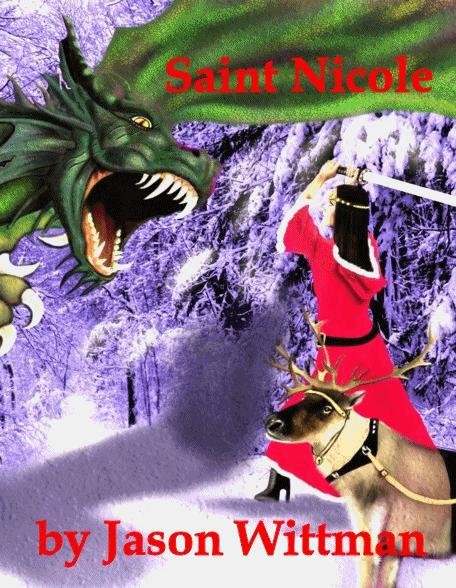
by Jason D. Wittman
When Anne invited me to discuss my novella Saint Nicole on her blog, I was not sure what to write at first. Most writers grow uncomfortable when asked, "Where do you get the ideas for your stories?"
The reason for this is that the people who ask that question seem to expect some fascinating, eye-opening answer, like: "I was playing Nikolai Rimsky-Korsakov's Flight of the Bumblebee on my bagpipes one day, when suddenly it occurred to me..." In reality, most sources of inspiration are depressingly ordinary. Stephen R. Donaldson, for instance, has famously said he was once inspired by a can of Lysol disinfectant in a men's room at a convenience store.
Me, I get my inspirations from other sources. One time, some co-workers and I were discussing funny t-shirts we had seen, and I told them of one that said "Schrodinger's cat is dead," on the front and "Schrodinger's cat is not dead," on the back. My co-workers all gave me blank stares. And as I struggled to think of a way to explain the concept of Schrodinger's cat to them, my short story The Sarcophagus of Lady Schrodinger was born.
 The inspiration for Saint Nicole, though, did not come from a t-shirt. It came from those newspaper articles you see whenever Christmastime rolls around that tell of how the various Christmas traditions came to be -- the Christmas tree, for instance, comes from Germany; while mistletoe was originally used in druidic rituals. This got me pulling together a mythical "origin story" of how all these ancient traditions joined forces to become what we know now as Christmas. And that phrase "joined forces" put me in mind of an epic conflict, where the peoples of various cultures come together to defeat a common enemy, in the vein of The Lord of the Rings. There would be mortal human beings, of course, and joining them would be the Fair Folk, as well as the Thunder People, vaguely representing the Norse, and the Lightning People, representing the Greeks. I also put in a mysterious figure called the Silent Knight, and the Five Golden Rings, powerful magic talsimans inspired by The Lord of the Rings and the old song "The Twelve Days of Christmas."
Santa Claus, or St. Nicholas, would have to be involved, of course. Eventually, I got the idea of there not being one, but generations of them, each inheriting the role from his father when the time came. And this inspired a further twist: what if a Nicholas died without any male heir? What if he only had a daughter? And so our heroine Nicole was born, who finds herself assuming her father's mantle when he is killed by his ancient archenemy...
Archenemy. Let's see now. What kind of archenemy would be appropriate for this story? Well, since Christmas is all about the bestowing of gifts, and of Peace on Earth, Good Will to All, it seemed to me that the story's main antagonist would have to be the most sociopathic, solipsistic creature ever born. And so I came up with the dragon Furnaceheart, whose one single goal in existence is to eat everything and everyone in existence. Throughout the entire novella, he cannot understand why all this yummy food does not want to be eaten. Don't they understand that's what food is for? I wrote an entire chapter of the novella from Furnaceheart's point of view, and it was extremely fun to write an interior monologue with that kind of mindset. I like to think I got it right.
In the end, it falls to the young, inexperienced Nicole to defeat this vile foe. If you want to know how she fares, you will have to read the novella itself.
* * *
Learn more about Jason D. Wittman on his blog.
Purchase Saint Nicole from Alban Lake Publishing.


