Thursday, May 19, 2016
Thursday, May 12, 2016
J.L. Gribble's Adventures in Outlining Her Novel STEEL VICTORY
In March I had the pleasure of being a guest author at Cleveland ConCoction. On the last day of the con, as I sat in the book room, I started a conversation with my neighbor. J.L. Gribble was selling her novel Steel Victory, the first in her Steel Empires series for Dog Star Books. She kindly agreed to stop by Jester Harley's Manuscript Page to tell us her outlining secrets. Listen up!
* * *
Adventures in Outlining
Though I didn’t write my debut novel, Steel Victory, with the intention of turning it into a series, I
jumped at the chance to do so at the invitation of my publisher. Unfortunately,
that means actually writing the series! After a brief moment of panic, I got
into the swing of things and committed to publishing a novel a year for what is
now known as the Steel Empire series. While Steel
Victory was published in summer of 2015, and its sequel, Steel Magic, is set to be released this
upcoming July, I’ve also already completed a full draft of book 3 and a full scene-by-scene
outline of book 4.
Writing a book is pretty much, well, writing a book, but one
part of the process I’ve managed to do completely differently every single time
is the outline stage. Two terms often used for writers are those who are
“plotters” (who have the entire story down before they begin the first draft)
and “pantsers” (who make everything up as they go along). Time to do some
compare and contrast!
Book 1
Steel Victory was
written during the course of a two-year graduate program. I knew what sort of
book I wanted to write—urban fantasy, alternate history, nontraditional
vampires, strong family bonds—but the actual plot was a different matter. I knew
where I was going a few scenes in advance, but once I wrote those few scenes,
it was back to square one until I came up with what happened next. This is
pretty much the definition of pantsing.
Pros
It is very easy to switch directions using this method
because you’re not locked into anything if genius strikes while you’re out for
a walk or driving somewhere. Or in my case, in the shower.
Cons
I had a ton of clean-up work to do on the book afterward.
Some scenes needed to be restructured and I ended up cutting over 10k words
from the final version because a few more scenes were ultimately useless
because I hadn’t quite nailed down where I was going at that point.
Book 2
Because I was on more of a time crunch to draft and revise
my second novel (one year versus two), I knew that I needed to find a better
method. For Steel Magic, I started
with a full road map (the plotter method). Before I wrote one word of the
novel, I had almost 5k words of a detailed outline. I knew what was going to
happen in every scene, down to the locations and minor characters involved.
Pros
There was never a break in the action. This was especially
helpful during NaNoWriMo (National Novel Writing Month), when I wrote a full
50k words of the novel in 30 days. I never had to sit back and wonder what was
going to happen next.
Cons
Sometimes I did come up with a few tweaks or a better way to
handle the story, and when that happened, I had to go back to my outline and
make sure I wasn’t going to write myself into a corner or cause any major plot
holes down the line.
Book 3
With another book to write in a single year, I knew I had to
stay with the full plotting method. This book I switched it up once again,
because I had set myself the goal of a traditional Romeo & Juliet plot
(with bonus feminism) set in my world, with my characters. So my scene-by-scene
outline was a direct scene-by-scene retelling of Shakespeare’s play. As a former
English major, this was both a challenge and a blast.
Pros
Because I was basing my story on such a classic tale, I had
a blast figuring out my twist on it. It’s not that most of the work was done
for me, especially considering my version has a few more epic battles between
weredragons and vampires, but having a solid jumping off point certainly made
things a bit easier.
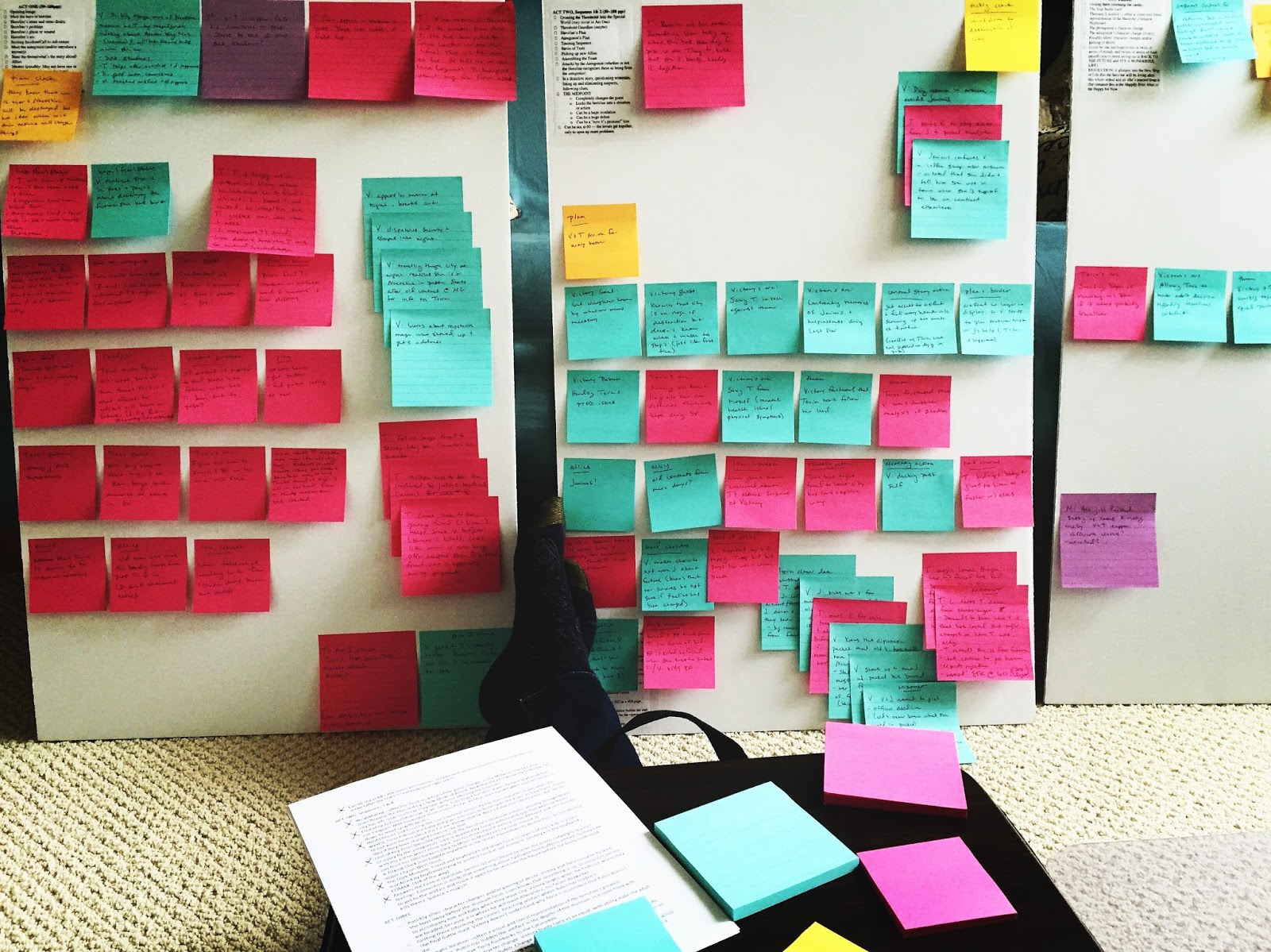
| Outlining book 4 using the Three Act Structure template. |
Cons
The narrative structure of a stage play written hundreds of
years ago is a tad different from a popular fiction novel of today. I have many
more major revisions still in progress for this book based on some critiques
from beta readers, in which some scenes need more conflict and at least one
needs to be cut completely.
Book 4
At a writing retreat a few months ago, I learned about another
outline method called the Three Act Structure used in conjunction with lots of note
cards. (For more information on Three Act Structure, click here.) I decided to use this one for my latest book, which involved figuring out all
of the major themes and plot points and then filling them out into individual
scenes. For me, this involved lots of colorful post-it notes and poster board
in for office for my cats to knock over.
Pros
The template provides a great list of things that should be
included in a novel, like character goals and the dark moment before the act.
This was a helpful guide for really digging into the meat of the story I was
trying to tell.
Cons
I ended up with a lot of major events and nothing in
between. Figuring out the smaller conflicts while maintaining a good pace was
more difficult than I expected it to be.
What I Learned
This is probably where you expect me to tell you what the
best method is, right? Absolutely not. One of my favorite things about the art
of writing is that there is no one, true way. Through trial and error, I’ve
learned which way works the best for me. The book 2 method: organically
outlining in chronological order, by the way. Since I’m not planning anymore
rewrites of long-dead playwrights, I think I’ll stick with this for the rest of
the series. And to be honest, when I read other novels, I can almost never tell
what sort of method the author started out with anyway!
The last few years have been an adventure, but now that I’ve
found what works for me, I can’t wait to jump into future projects. After I
actually write book 4, of course.
* * *
Purchase Steel Victory on Amazon.
Labels:
fantasy,
Guest blogger J.L. Gribble,
J. L. Gribble,
outlining,
series
Sunday, May 1, 2016
Launch Day Joy: MOSAICS Vol 2 Indie Women Authors #IAmAMosaic
It's time! Volume 2 of the Mosaics anthology series is out. Stories and poems by and about strong women.
One of the editors, Kim Wells, made this gorgeous promo card for my story, "No One's Land."
And here's a video featuring everybody's story cards:
Oh, and you're welcome to stop by the Facebook party tonight (May 1) from 5:00pm to 7:00pm Central time.
But most important, please pop over to Amazon and buy this wonderful book.
Labels:
anthology,
feminist,
Mosaics,
short stories
Thursday, April 14, 2016
Planet of the Eggs #Comicbook Series Publishes a New Issue!
Coolness alert! My guests today are the writer and illustrator team who create Planet of the Eggs, a dinosaur-themed comic book series. Peggy Bechko and Charlene Sorensen stopped by to discuss their process.
* * *
Welcome to Eggland!
by Peggy Bechko and Charlene Sorensen
Peggy Bechko, frequently published author (genres including Romance, SciFi and Western) and optioned screenwriter teamed up with long time friend and former health insurance industry denizen, Charlene Sorensen to bring the world a new world...Eggland.
Friends for many years, Peggy was ready to embark on a whole new venture - comics!
And Charlene was ready to stretch her creative wings.
Together they created the new Planet Of The Eggs Comic Book series. The first in this 'eggciting' adventure across time, space and who-knows-what, Cracked Open, introduced the Six Eggs of Legend and was followed by the second Grimoire: Book of spells, the third, Mummified Egg and the fourth Eruption (the first of a two part adventure). There are many adventures yet left to tell.
The writing/illustrating team, living in the foothills of the high mountains just five minutes apart, is geared up, creating the second in the two part adventure Eruption and Saving Dot. and have reached a point where one can read the other's mind. Even artistic disagreements are arrived at simultaneously. They spend two to three days a week together, creating jointly and time apart creating illustrations, working on their newsletter and pondering what might come next for the well-armed eggs.
For Peggy, an author who’d always created alone previously, what happens when things change? When the career takes yet another turn (most careers have many of those turns) and life hands this writer a new direction and simultaneously a writing partner?
With a great writing partner, things pop and sizzle as never before. We end each other’s sentences and marvel at one another’s ideas. Effortless. Satisfying. Fun! It gives us chills!
And I guess one would call what we do, creating more than simply writing. We created our own project, a new comic series called Planet Of The Eggs. We learned new software, created story lines, wrote scripts, designed characters from scratch and pulled the whole thing together in an ‘indy’ published comic es, not to mention creating designs for our CafĂ© Press Planet Of The Eggs Shop. It was a learning curve the size of Mt. Everest, but it was a great climb. We work side-by-side two days a week and separately the rest of the time sending ideas, created comic characters and other bits and pieces back and forth via email. We’ve learned much about getting our work out there for people to enjoy. It’s a wonder we actually sleep. Actually it’s not clear that Charlene does.
Peggy and Charlene envision a long life for the Six Eggs of Legend as they move between the worlds, superpowers evolving, and fight the forces of evil to save Eggland. And a long and happy partnership in the creation.
* * *
Welcome to Eggland!
by Peggy Bechko and Charlene Sorensen
Peggy Bechko, frequently published author (genres including Romance, SciFi and Western) and optioned screenwriter teamed up with long time friend and former health insurance industry denizen, Charlene Sorensen to bring the world a new world...Eggland.
Friends for many years, Peggy was ready to embark on a whole new venture - comics!
And Charlene was ready to stretch her creative wings.
Together they created the new Planet Of The Eggs Comic Book series. The first in this 'eggciting' adventure across time, space and who-knows-what, Cracked Open, introduced the Six Eggs of Legend and was followed by the second Grimoire: Book of spells, the third, Mummified Egg and the fourth Eruption (the first of a two part adventure). There are many adventures yet left to tell.
The writing/illustrating team, living in the foothills of the high mountains just five minutes apart, is geared up, creating the second in the two part adventure Eruption and Saving Dot. and have reached a point where one can read the other's mind. Even artistic disagreements are arrived at simultaneously. They spend two to three days a week together, creating jointly and time apart creating illustrations, working on their newsletter and pondering what might come next for the well-armed eggs.
For Peggy, an author who’d always created alone previously, what happens when things change? When the career takes yet another turn (most careers have many of those turns) and life hands this writer a new direction and simultaneously a writing partner?
With a great writing partner, things pop and sizzle as never before. We end each other’s sentences and marvel at one another’s ideas. Effortless. Satisfying. Fun! It gives us chills!
And I guess one would call what we do, creating more than simply writing. We created our own project, a new comic series called Planet Of The Eggs. We learned new software, created story lines, wrote scripts, designed characters from scratch and pulled the whole thing together in an ‘indy’ published comic es, not to mention creating designs for our CafĂ© Press Planet Of The Eggs Shop. It was a learning curve the size of Mt. Everest, but it was a great climb. We work side-by-side two days a week and separately the rest of the time sending ideas, created comic characters and other bits and pieces back and forth via email. We’ve learned much about getting our work out there for people to enjoy. It’s a wonder we actually sleep. Actually it’s not clear that Charlene does.Peggy and Charlene envision a long life for the Six Eggs of Legend as they move between the worlds, superpowers evolving, and fight the forces of evil to save Eggland. And a long and happy partnership in the creation.
* * *
Learn more about Peggy, Charlene, and Planet of the Eggs on the official website or subscribe to their newsletter.
Purchase Planet of the Eggs: CRACKED OPEN on Amazon.
Purchase Planet of the Eggs: ERUPTION on Amazon.
Tuesday, April 5, 2016
Book Tour #Giveaway: Terri Bruce's New Novel, WHEREAFTER
I know Terri Bruce as a fellow member of Broad Universe, a society that supports women authors of speculative fiction. As a comrade in literary arms, I was delighted to host Terri's blog tour for her new novel, Whereafter.
And be sure to scroll down to the giveaway!
* * *
Making Believable Ghosts
by Terri Bruce
I’m so thrilled to be here today, celebrating the release of
my third novel, Whereafter (Afterlife #3). This is the third book in my
Afterlife series, which tells the story of a woman named Irene Dunphy who dies
and must learn to navigate the afterlife as a ghost.
I love mythology and the origins of myths, and one day while
driving to work, I started thinking about afterlife mythology. I wondered why
there were so many different and disparate descriptions of the afterlife if
they were all describing the same thing. I mean, realistically, if there is an
afterlife, we’re probably all going to the same place. So why is it described
so differently by different cultures? I started thinking maybe it was like “The
Blind Men and the Elephant”—that is, that all the stories were only describing
a part of it. So I tried to imagine what the afterlife would like if all the
afterlife stories were true. How would all these very different and sometimes
competing places exist together? When I read one myth that said the dead travel
to the afterlife via a tunnel of light but another that said it was via a
bridge, I tried to imagine a way in which that was possible. Well… maybe
different people saw different things—maybe it’s all based on perception. Maybe
they weren’t all crossing at the same place. After all, having lived on the
North Shore of Massachusetts for many years, I can tell you that sometimes I
traveled to work in Boston via a bridge (the Tobin Bridge) and sometimes by
tunnel (the Sumner and Callahan Tunnels). It depended on which road/route I was
traveling. It was also dependent on my mode of transportation—when I drove, I
took the bridge and when I took the bus/public transportation, we went through
the tunnel. So maybe that’s how it is for the dead.
When it came to reconciling the many different descriptions
of the physical landscape—especially the more strange/outlandish elements—I
realized that this could be explained as being different places within the same
world and also through the idea of higher planes of consciousness. This is
where I borrowed heavily from the Buddhist state of Bardo—an intermediate stage
between the physical realm and enlightenment where the person wrestles with
demons and visions that are a manifestation of the person’s subconscious. As
the person learns and becomes wiser/more enlightened, he/she is able to see
through the outward appearance of the demons to their true meaning. If we
thought of the afterlife as a place where people gain enlightenment, then
things might appear confusing or unexplainable at first. But as the person
gains more knowledge and insight—and ascends to a higher and higher planes of
being—then they can see more clearly. So, for instance, in the second book of
the series, Irene meets a cat that seems to be leading her through the
afterlife. To her, it looks like a cat, even though she’s pretty sure it’s not
an ordinary cat. Because she isn’t enlightened enough/ascended to a high enough
level, she can’t see its true form.
While I was trying to find a way to make all of the various
descriptions of the physical landscape work together, I also wanted to write a
world that was believable. I didn’t want it to be fantastical fantasy; I wanted
the mechanics—the physical rules of it—to be realistic, or, at least,
plausible. So I set out to also create realistic explanations for various
beliefs and folklore elements. If there really is an afterlife, why do people
travel to it through a tunnel of light? Why is it far away and not right here?
And why a tunnel of light? What is the function of the light in helping move
spirits from the physical realm to the afterlife? Or how about, why do some
ghosts see a tunnel, some seem to instantly be transported to the other side,
and some get stuck here and can’t cross over? What is the mechanics of that and
why it happens?
Another example: how is it that ghosts can walk through
walls and yet also move objects? To walk through walls they’d have to have no
mass and/or be pure energy. But if they move objects, they have to have mass,
right? So how can they both? At times, I began to feel like a physicist trying
to describe quantum mechanics (and honestly, after reading all the various
mythology, I’m starting to think it could all be plausible at a quantum
level!).
I’ve tried very hard to make sure that my world building is
realistic and consistent—this has often led to problems that were hard to
solve. If ghosts have mass (because they can move things) then how come we
can’t see them? But how come we can see them sometimes and other times they are
invisible? It’s been really difficult at times being consistent in the world
building when the stories are so inconsistent! But once I started thinking of
the afterlife as different planes/levels all stacked together and started
thinking in terms of different scales – the way that sub-atomic particles and
planets exist in the same space—then things began to make more sense… or, at
least, be more easily explained
Part of why I’ve loved writing this series is the
world-building challenge. Because I created these self-imposed rules (use ALL
of the stories and myths and make it all plausible) that I had to adhere to, it
really forced me to stretch and grow as a writer. It turns out, coming up with
realistic explanations for fantastical things requires MORE creativity than
just coming up with the fantastical things themselves. I always thought all of
the imagination and fun was in imagining new things, but then getting those
things to adhere to a set of rules requires a lot of ingenuity as well. And
it’s helped me to develop discipline as well. I could have given up on making
the world-building adhere to a strict set of rules (it certainly would have
been easier) but I don’t think the books would have been as good. Many readers
of the series like how the books feel like they could be real/how the
world-building is believable. So, developing that discipline has been a good
thing for both me and my readers.
For anyone that loves afterlife mythology or wants to learn
more about the Afterlife series, during the month of April I will be
participating in the “A to Z Blogging Challenge,” and every day, I will be
posting a video blog (at http://www.terribruce.net) in which I reveal all of
the hidden references to afterlife mythology and “Easter Eggs” in the series. I
encourage everyone to stop by each day and check out the videos! You can also
sign up for my newsletter to stay up to date with all my latest news. In
addition, I love interacting with readers, so please feel free to email me or
connect with me on Twitter!
a Rafflecopter giveaway
Excerpt from Whereafter:
Andras grunted,
the sound filled with suspicion. Irene bent down to tie her shoelace, as much
to avoid eye contact as anything. When she straightened up, something in the
distance caught her eye, shimmering like a mirage. She squinted, not sure she
was really seeing what she thought she saw.
“You know, now
might be a good time for you to tell me what it was like to live in a castle,”
she said.
Andras shook his
head, sadly, as if Irene had disappointed him. “You cling too much to the past.
Forget the trappings of life. Free your mind from these longings, and so, free
your soul. Only then will we be able to escape these shackles and enter Heaven
to rest at the side of God.”
Why did he always
have to argue about everything? “For God’s sake,” she said, exasperated, “just
answer the question!”
“Wherefore?”
Irene pointed to
the hulking structure in the distance. “Because,” she said as Andras whirled
around to see what she was pointing at, “correct me if I’m wrong, but that
looks like a castle.”
“Wow!” Irene said,
her eyes roving over the dark, crenellated structure hulking in the far
distance. It gleamed dully, the color of burnt blood in a fading afternoon sun.
“What the hell do you think that is?”
Andras grunted.
“As you said—Hell.”
Irene frowned at
him, but her lips quirked in amusement. “Why do you have to be so negative? It
could just as easily be Heaven. God is supposed to live in a palace, right—the
whole ‘my father’s house has many rooms’ thing? A castle is just a type of
palace.”
Andras gave her a
dry look. “Does that look like Heaven?”
Irene was on the
verge of agreeing that the castle did not in any way look how she imagined
Heaven when it shimmered, as if the fading sunlight had been redirected by
mirrors. Light rippled across the castle’s surface and the dull, dark,
burnt-blood color transformed into gleaming, bright, silver-white. Crisp white
pennants flapped from the corners as if whipped by wind. Irene thought she
could hear them snapping crisply.
Irene looked at
Andras, and he looked at her. His expression made it clear that he had seen the
same transformation she had. It was as if the building was trying to trick them
into coming closer.
* * *
Learn more about Terri Bruce on her website and Goodreads.
Purchase Whereafter at Amazon and other retailers.
Labels:
Afterlife,
blog tour,
book launch,
ghosts,
Guest blogger Terri Bruce,
paranormal,
series,
Whereafter
Tuesday, March 22, 2016
Enter the SPACE SURFERS #YAlit #scifi adventure novel giveaway on Goodreads!
Goodreads Book Giveaway
Space Surfers
by Anne E. Johnson
Giveaway ends April 26, 2016.
See the giveaway details at Goodreads.
Tuesday, March 8, 2016
Launch and #Giveaway! Mosaics Vol. 1: A Collection of Independent Women #feminism #womenwriters
Today's the day! Mosaics is out in the world. I would be excited about this anthology no
matter what, but I'm delighted to say that I will have a story in volume 2. Let's give volume 1 a hearty launch!
All the excitement, all the anticipation, and now it's finally here. And don't forget to enter the mega giveaway, including a Kindle Fire, a $50 gift card, and a paperback library, at the end of this post!
A project focused on bringing women's voices to readers and celebrating the stories they have to tell. Including stories by Keyan Bowes, Carol Cao, Chelo Diaz-Ludden, Sarina Dorie, NaoMosaics: A Collection of Independent Women Vol 1
Buy Your Copy Now!
Mosaics: A Collection of Independent Women will inspire and shock you with its multi-faceted look at the history and culture surrounding femininity. If gender is a construct, this anthology is the house it built. Look through its many rooms, some bright and airy, some terrifying- with monsters lurking in the shadows.
Mosaics Volume One features twenty self-identified female authors writing about Intersectionality, including women of color, and members of the disability, trans, and GLB/ GSD* (Gender and Sexual Diversities) communities. We have curated amazing short fiction, flash fiction, poetry, essays, and art. It’s personal, political, and a great read.
This collection includes Hugo Award Nominees, Tiptree Shortlists, Pushcart Prize Winners, USA Today Bestsellers, indie superstars and traditionally published talents alike. The anthology combines leading and new voices all proclaiming their identity as Women, and their ability to Roar.
Buy Your Copy Now!
Labels:
anthologies,
book launch,
feminist,
Mosaics,
women
Subscribe to:
Posts (Atom)