Showing posts with label series. Show all posts

Wednesday, July 27, 2016

Acquisition Announcement: Candlemark & Gleam welcomes a new Webrid novel

Hey, Webrid fans!

You helped everyone's favorite snarky carter figure out where that laser in his forehead came from in GREEN LIGHT DELIVERY.

You watched Webrid and friends keep their solar system from cracking apart in BLUE DIAMOND DELIVERY.

And now I am thrilled to report that Candlemark & Gleam Publishing has officially announced the acquisition of RED SPAWN DELIVERY. Poor Webrid, who just wants to sit around guzzling booze, has to hop from planet to planet, chasing down fifty kidnapped alien spider babies. This was not what he had planned for the week.

And if you have not yet been introduced to Webrid or the other madcap characters in the Raralt Planetary Circle, I promised you'll be tickled. These novels have been described as a cross between Douglas Adams and Raymond Chandler, so you know you won't be bored!

See the official announcement on the Candlemark & Gleam blog. The novel is scheduled for release in early 2017.


Thursday, May 12, 2016

J.L. Gribble's Adventures in Outlining Her Novel STEEL VICTORY


In March I had the pleasure of being a guest author at Cleveland ConCoction. On the last day of the con, as I sat in the book room, I started a conversation with my neighbor. J.L. Gribble was selling her novel Steel Victory, the first in her Steel Empires series for Dog Star Books. She kindly agreed to stop by Jester Harley's Manuscript Page to tell us her outlining secrets. Listen up!

*   *   *

Adventures in Outlining
By J.L. Gribble

Though I didn’t write my debut novel, Steel Victory, with the intention of turning it into a series, I jumped at the chance to do so at the invitation of my publisher. Unfortunately, that means actually writing the series! After a brief moment of panic, I got into the swing of things and committed to publishing a novel a year for what is now known as the Steel Empire series. While Steel Victory was published in summer of 2015, and its sequel, Steel Magic, is set to be released this upcoming July, I’ve also already completed a full draft of book 3 and a full scene-by-scene outline of book 4.

Writing a book is pretty much, well, writing a book, but one part of the process I’ve managed to do completely differently every single time is the outline stage. Two terms often used for writers are those who are “plotters” (who have the entire story down before they begin the first draft) and “pantsers” (who make everything up as they go along). Time to do some compare and contrast!

Book 1
Steel Victory was written during the course of a two-year graduate program. I knew what sort of book I wanted to write—urban fantasy, alternate history, nontraditional vampires, strong family bonds—but the actual plot was a different matter. I knew where I was going a few scenes in advance, but once I wrote those few scenes, it was back to square one until I came up with what happened next. This is pretty much the definition of pantsing.

Pros
It is very easy to switch directions using this method because you’re not locked into anything if genius strikes while you’re out for a walk or driving somewhere. Or in my case, in the shower.

Cons
I had a ton of clean-up work to do on the book afterward. Some scenes needed to be restructured and I ended up cutting over 10k words from the final version because a few more scenes were ultimately useless because I hadn’t quite nailed down where I was going at that point.

Book 2
Because I was on more of a time crunch to draft and revise my second novel (one year versus two), I knew that I needed to find a better method. For Steel Magic, I started with a full road map (the plotter method). Before I wrote one word of the novel, I had almost 5k words of a detailed outline. I knew what was going to happen in every scene, down to the locations and minor characters involved.

Pros
There was never a break in the action. This was especially helpful during NaNoWriMo (National Novel Writing Month), when I wrote a full 50k words of the novel in 30 days. I never had to sit back and wonder what was going to happen next.

Cons
Sometimes I did come up with a few tweaks or a better way to handle the story, and when that happened, I had to go back to my outline and make sure I wasn’t going to write myself into a corner or cause any major plot holes down the line.

Book 3
With another book to write in a single year, I knew I had to stay with the full plotting method. This book I switched it up once again, because I had set myself the goal of a traditional Romeo & Juliet plot (with bonus feminism) set in my world, with my characters. So my scene-by-scene outline was a direct scene-by-scene retelling of Shakespeare’s play. As a former English major, this was both a challenge and a blast.

Pros
Because I was basing my story on such a classic tale, I had a blast figuring out my twist on it. It’s not that most of the work was done for me, especially considering my version has a few more epic battles between weredragons and vampires, but having a solid jumping off point certainly made things a bit easier.

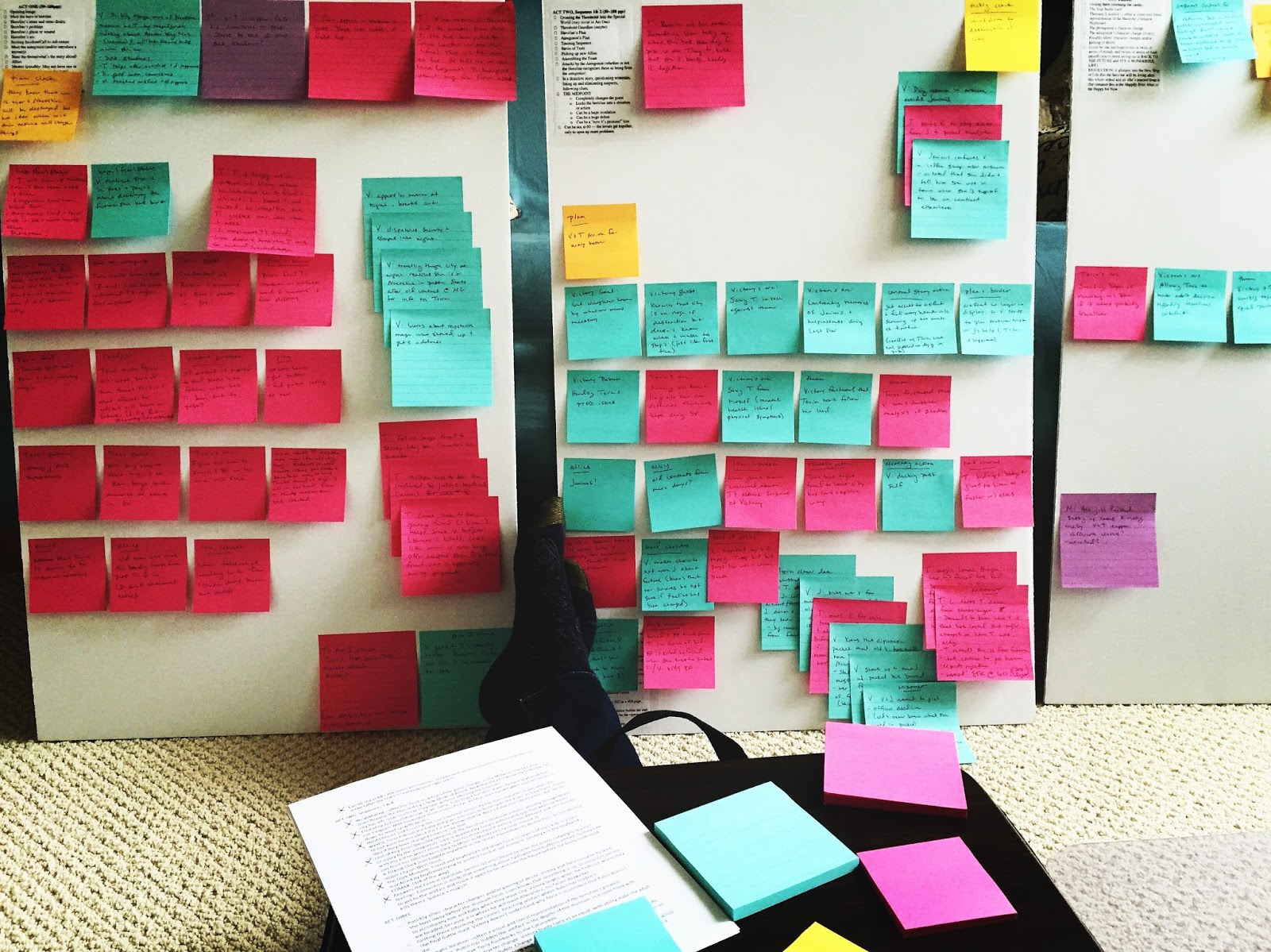
Outlining book 4 using the Three Act Structure template.
Cons
The narrative structure of a stage play written hundreds of years ago is a tad different from a popular fiction novel of today. I have many more major revisions still in progress for this book based on some critiques from beta readers, in which some scenes need more conflict and at least one needs to be cut completely.

Book 4
At a writing retreat a few months ago, I learned about another outline method called the Three Act Structure used in conjunction with lots of note cards. (For more information on Three Act Structure, click here.) I decided to use this one for my latest book, which involved figuring out all of the major themes and plot points and then filling them out into individual scenes. For me, this involved lots of colorful post-it notes and poster board in for office for my cats to knock over.

Pros
The template provides a great list of things that should be included in a novel, like character goals and the dark moment before the act. This was a helpful guide for really digging into the meat of the story I was trying to tell.

Cons
I ended up with a lot of major events and nothing in between. Figuring out the smaller conflicts while maintaining a good pace was more difficult than I expected it to be.

What I Learned
This is probably where you expect me to tell you what the best method is, right? Absolutely not. One of my favorite things about the art of writing is that there is no one, true way. Through trial and error, I’ve learned which way works the best for me. The book 2 method: organically outlining in chronological order, by the way. Since I’m not planning anymore rewrites of long-dead playwrights, I think I’ll stick with this for the rest of the series. And to be honest, when I read other novels, I can almost never tell what sort of method the author started out with anyway!

The last few years have been an adventure, but now that I’ve found what works for me, I can’t wait to jump into future projects. After I actually write book 4, of course.

*   *   *

Learn more about J.L. Gribble on her website, Facebook, and on Twitter/Instagram @hannaedits.

Purchase Steel Victory on Amazon.


Tuesday, April 5, 2016

Book Tour #Giveaway: Terri Bruce's New Novel, WHEREAFTER


I know Terri Bruce as a fellow member of Broad Universe, a society that supports women authors of speculative fiction. As a comrade in literary arms, I was delighted to host Terri's blog tour for her new novel, Whereafter.

And be sure to scroll down to the giveaway!

*   *   *
Making Believable Ghosts
by Terri Bruce

I’m so thrilled to be here today, celebrating the release of my third novel, Whereafter (Afterlife #3). This is the third book in my Afterlife series, which tells the story of a woman named Irene Dunphy who dies and must learn to navigate the afterlife as a ghost.

I love mythology and the origins of myths, and one day while driving to work, I started thinking about afterlife mythology. I wondered why there were so many different and disparate descriptions of the afterlife if they were all describing the same thing. I mean, realistically, if there is an afterlife, we’re probably all going to the same place. So why is it described so differently by different cultures? I started thinking maybe it was like “The Blind Men and the Elephant”—that is, that all the stories were only describing a part of it. So I tried to imagine what the afterlife would like if all the afterlife stories were true. How would all these very different and sometimes competing places exist together? When I read one myth that said the dead travel to the afterlife via a tunnel of light but another that said it was via a bridge, I tried to imagine a way in which that was possible. Well… maybe different people saw different things—maybe it’s all based on perception. Maybe they weren’t all crossing at the same place. After all, having lived on the North Shore of Massachusetts for many years, I can tell you that sometimes I traveled to work in Boston via a bridge (the Tobin Bridge) and sometimes by tunnel (the Sumner and Callahan Tunnels). It depended on which road/route I was traveling. It was also dependent on my mode of transportation—when I drove, I took the bridge and when I took the bus/public transportation, we went through the tunnel. So maybe that’s how it is for the dead.

When it came to reconciling the many different descriptions of the physical landscape—especially the more strange/outlandish elements—I realized that this could be explained as being different places within the same world and also through the idea of higher planes of consciousness. This is where I borrowed heavily from the Buddhist state of Bardo—an intermediate stage between the physical realm and enlightenment where the person wrestles with demons and visions that are a manifestation of the person’s subconscious. As the person learns and becomes wiser/more enlightened, he/she is able to see through the outward appearance of the demons to their true meaning. If we thought of the afterlife as a place where people gain enlightenment, then things might appear confusing or unexplainable at first. But as the person gains more knowledge and insight—and ascends to a higher and higher planes of being—then they can see more clearly. So, for instance, in the second book of the series, Irene meets a cat that seems to be leading her through the afterlife. To her, it looks like a cat, even though she’s pretty sure it’s not an ordinary cat. Because she isn’t enlightened enough/ascended to a high enough level, she can’t see its true form.

While I was trying to find a way to make all of the various descriptions of the physical landscape work together, I also wanted to write a world that was believable. I didn’t want it to be fantastical fantasy; I wanted the mechanics—the physical rules of it—to be realistic, or, at least, plausible. So I set out to also create realistic explanations for various beliefs and folklore elements. If there really is an afterlife, why do people travel to it through a tunnel of light? Why is it far away and not right here? And why a tunnel of light? What is the function of the light in helping move spirits from the physical realm to the afterlife? Or how about, why do some ghosts see a tunnel, some seem to instantly be transported to the other side, and some get stuck here and can’t cross over? What is the mechanics of that and why it happens?

Another example: how is it that ghosts can walk through walls and yet also move objects? To walk through walls they’d have to have no mass and/or be pure energy. But if they move objects, they have to have mass, right? So how can they both? At times, I began to feel like a physicist trying to describe quantum mechanics (and honestly, after reading all the various mythology, I’m starting to think it could all be plausible at a quantum level!).

I’ve tried very hard to make sure that my world building is realistic and consistent—this has often led to problems that were hard to solve. If ghosts have mass (because they can move things) then how come we can’t see them? But how come we can see them sometimes and other times they are invisible? It’s been really difficult at times being consistent in the world building when the stories are so inconsistent! But once I started thinking of the afterlife as different planes/levels all stacked together and started thinking in terms of different scales – the way that sub-atomic particles and planets exist in the same space—then things began to make more sense… or, at least, be more easily explained

Part of why I’ve loved writing this series is the world-building challenge. Because I created these self-imposed rules (use ALL of the stories and myths and make it all plausible) that I had to adhere to, it really forced me to stretch and grow as a writer. It turns out, coming up with realistic explanations for fantastical things requires MORE creativity than just coming up with the fantastical things themselves. I always thought all of the imagination and fun was in imagining new things, but then getting those things to adhere to a set of rules requires a lot of ingenuity as well. And it’s helped me to develop discipline as well. I could have given up on making the world-building adhere to a strict set of rules (it certainly would have been easier) but I don’t think the books would have been as good. Many readers of the series like how the books feel like they could be real/how the world-building is believable. So, developing that discipline has been a good thing for both me and my readers.

For anyone that loves afterlife mythology or wants to learn more about the Afterlife series, during the month of April I will be participating in the “A to Z Blogging Challenge,” and every day, I will be posting a video blog (at http://www.terribruce.net) in which I reveal all of the hidden references to afterlife mythology and “Easter Eggs” in the series. I encourage everyone to stop by each day and check out the videos! You can also sign up for my newsletter to stay up to date with all my latest news. In addition, I love interacting with readers, so please feel free to email me or connect with me on Twitter!

a Rafflecopter giveaway

Excerpt from Whereafter:

Andras grunted, the sound filled with suspicion. Irene bent down to tie her shoelace, as much to avoid eye contact as anything. When she straightened up, something in the distance caught her eye, shimmering like a mirage. She squinted, not sure she was really seeing what she thought she saw.
“You know, now might be a good time for you to tell me what it was like to live in a castle,” she said.
Andras shook his head, sadly, as if Irene had disappointed him. “You cling too much to the past. Forget the trappings of life. Free your mind from these longings, and so, free your soul. Only then will we be able to escape these shackles and enter Heaven to rest at the side of God.”
Why did he always have to argue about everything? “For God’s sake,” she said, exasperated, “just answer the question!”
“Wherefore?”
Irene pointed to the hulking structure in the distance. “Because,” she said as Andras whirled around to see what she was pointing at, “correct me if I’m wrong, but that looks like a castle.”
“Wow!” Irene said, her eyes roving over the dark, crenellated structure hulking in the far distance. It gleamed dully, the color of burnt blood in a fading afternoon sun. “What the hell do you think that is?”
Andras grunted. “As you said—Hell.”
Irene frowned at him, but her lips quirked in amusement. “Why do you have to be so negative? It could just as easily be Heaven. God is supposed to live in a palace, right—the whole ‘my father’s house has many rooms’ thing? A castle is just a type of palace.”
Andras gave her a dry look. “Does that look like Heaven?”
Irene was on the verge of agreeing that the castle did not in any way look how she imagined Heaven when it shimmered, as if the fading sunlight had been redirected by mirrors. Light rippled across the castle’s surface and the dull, dark, burnt-blood color transformed into gleaming, bright, silver-white. Crisp white pennants flapped from the corners as if whipped by wind. Irene thought she could hear them snapping crisply.
Irene looked at Andras, and he looked at her. His expression made it clear that he had seen the same transformation she had. It was as if the building was trying to trick them into coming closer.


*   *   *
Learn more about Terri Bruce on her website and Goodreads.
Purchase Whereafter at Amazon and other retailers.


Thursday, October 29, 2015

Gail Z. Martin talks Alternative History in her Day of the Dead blog tour.


Please welcome Gail Z. Martin, whose novels with Solaris Books include the upcoming Vendetta: A Deadly Curiosities Novel in her urban fantasy series set in Charleston, SC, and The Jake Desmet Adventures a new Steampunk series co-authored with Larry N. Martin. I asked Gail to tell us a bit about what it means to write "alternative history."
*   *   *

What Flavor is your Alternative History?
By Gail Z. Martin

What do you think of when the term ‘alternative history’ comes up?

Some people think of pivotal battles or moments in history. What if Hitler had won World War II? What if the Confederacy had won the Civil War? What if Lincoln had stayed home instead of going to Ford’s Theater? From that altered battle or event, the new timeline moves forward, and the author imagines a world different from our own.

Sometimes, the change is more subtle. What if an invention had come along earlier, later, or not at all? What if an influential philosopher or politician who is credited with setting a movement or ideology into motion never lived? That begs the question of whether or not an idea or invention would have come along eventually, if not by the person in our timeline who developed it, then by someone else. But what difference would a delay (or advance) in timing make?

Imagine the different route history might take if a natural disaster (like Hurricane Katrina or the explosion of Mt. Vesuvius that buried Pompeii) never happened. Or if a narrowly-averted natural disaster (the many hurricanes that veered away from making landfall on the East Coast at Category 5 status, for example) did happen? In a nod to the famed ‘butterfly effect’, that a tiny, random change that seems insignificant (like the flapping of a butterfly’s wings) can cause a huge difference when the ramifications play out. Many stories have been written about the difference one ‘average’ life makes (think “It’s a Wonderful Life”, which is really alternate history).

In Iron and Blood, the steampunk series co-authored with my husband, Larry N. Martin, we take a look at a Victorian Pittsburgh with crucial differences. In the real world, inventor George Washington worked briefly with genius Nikola Tesla, and then they went their separate ways. In our world, they found Tesla-Westinghouse Corporation, a nexus for steam-powered inventions. A disastrous flood, fire and earthquake that didn’t happen in real life occurs in our steampunk world, leading to the rise of the shadowy Oligarchy who stepped in to impose order after the catastrophes. That same Oligarchy sabotaged the nascent oil industry at Drake Well, so that steam power remained ascendant over petroleum.
Those are just a few of the altered details, but the ripple effect on history becomes larger and larger as time goes on, and it affects everything about the story and the characters, making the book a tale that could only happen in that alternative timeline.
One of the coolest things about alternative history is how it gives us a different lens to look at actions and consequences, to trace back how we got to where we are now and what might have changed that, and where we could have ended up. So whether you like your alternative history as steampunk, military adventure, sci-fi or fantasy, there are plenty of flavors to choose from!

My Days of the Dead blog tour runs through October 31 with never-before-seen cover art, brand new excerpts from upcoming books and recent short stories, interviews, guest blog posts, giveaways and more! Plus, I’ll be including extra excerpt links for my stories and for books by author friends of mine. You’ve got to visit the participating sites to get the goodies, just like Trick or Treat! For details, click here.

About Iron & Blood
Jake Desmet and Rick Brand, heirs to the Brand & Desmet Import Company, travel the world to secure treasures and unusual items for the collections of wealthy patrons, accompanied by Jake's cousin, Veronique 'Nicki' LeClercq . Smuggling a small package as a favor for a Polish witch should have been easy. But when hired killers come after Jake and a Ripper-style killer leaves the city awash in blood, Jake, Rick and Nicki realize that dark magic, vampire power struggles and industrial sabotage are just a prelude to a bigger plot that threatens New Pittsburgh and the world. Stopping that plot will require every ounce of Jake's courage, every bit of Rick's cunning, every scintilla of Nicki's bravura and all the steampowered innovation imaginable.
Extra Days of the Dead Trick or Treat Freebies!

*   *   *
You can read an excerpt from the upcoming Vendetta here.
Purchase Iron & Blood on Amazon.
Get yourself some book swag here (before Nov. 1).

Thursday, September 17, 2015

Barbara Gaskell Denvil introduces the world to her medieval historical fiction


Always happy to have a writer of historical fiction as my guest. This week we have the talented and prolific Barbara Gaskell Denvil, who talks with such enthusiasm about writing her medieval English novels that you can't help but want to read them!

*   *   *
INTRIGUING TALES OF ORDINARY PEOPLE
By Barbara Gaskell Denvil


Echoes in the night, running footsteps on the cobbles, the flicker of a candle flame at a window, distorted behind thick green-tinged glass. Outside in London’s alleyways the darkness is intense as the moon is hidden behind the rooftops with their soaring chimneys. But suddenly there’s the flare of a torch and its sizzle of fire. The Watch is coming – following – calling!  But the light is then extinguished, in the wind. Panting, losing breath, whispers. The lanes are narrow and the central gutters are thick with rubbish. The footsteps continue,  though now fainter in the distance. He is getting away.

Dreams. Visions. Inspiration. Hauntings.

I write historical fiction, and my books are set in late medieval England around the latter half of the 15th century. There’s a reason for this, for I have dreamed of such things all my life and the episode above is a typical night’s journey into the past. Even while living a highly romantic life for some years on a yacht sailing the sunny Mediterranean, I slipped into those medieval paths of my dreams.

When I started, many, many years ago, to seriously research the period that I already visited once asleep, I found an absorbing fascination in such details. This has never abated. I love to study the principal characters of the era, such as Richard III, Edward IV, Henry VII and all their amazing lords, ladies, courtiers and followers. But it is the ordinary people who inspire me most of all, along with their intriguing lives, limitations, desperate struggles and beliefs .

I have always been an author of sorts, an editor, critic, journalist, short story writer, screenwriter, and most of all a reader. And so it came naturally for me to write about the experiences which were already nightly dramas. I have now written several historical novels based around this late medieval period, and although my plots are centred around genuine historical characters and events, it is my own multi-layered storylines inhabited by beggars and soldiers, prostitutes and butchers, thieves and orphaned children, which interest me the most. My books are long – sorry – but with a huge cast of characters and depth of plot, a short book would be inadequate. After all, it takes a long book to relate all the interweaving mystery, adventure, crime and romance that my books involve. I am fussy about historical accuracy, but it is bringing my individual characters to life which I particularly love, since they all quickly become my great friends – even the villains – and I continue caring for them long after the book is finished.

Two of my historical novels have been on sale for some time in Australia where I now live – but I have recently made them available worldwide and now have great pleasure in announcing that SATIN CINNABAR, SUMERFORD’S AUTUMN and BLESSOP’S WIFE are all available worldwide on Amazon.

BLESSOP’S WIFE (published as The King’s Shadow in Australia) is a tale of crime, mystery and espionage set against the turbulent times when Edward IV died, and events led to Richard III accepting the throne. SATIN CINNABAR actually starts on the battlefield of Bosworth as Henry Tudor claims the crown of England from Richard III. SUMERFORD’S AUTUMN takes place during the first years of the dawning Tudor dynasty when the pretender known as Perkin Warbeck appears in England, claiming to be the rightful king. These books do not lead on one from the other, and each has its individual story and characters. But the dark and troublesome background of late medieval England persists – on the page just as it does in my head.

I continue to write of course, every day at my computer with the glorious Australian scenery and wildlife outside my window for inspiration. Rather a contrast to dark medieval alleys, but the peace and beauty are great for concentrating the mind. All I hear is wind in the trees and birdsong – then the click, click of my keyboard. So there are many more books to come -----


Blurb for BLESSOP’S WIFE

1483 and Edward IV wears England’s crown, but no king rules unchallenged. Often it is those closest to him who are the unexpected danger. When the king dies suddenly, rumour replaces fact – and Andrew Cobham is already working behind the scenes.
Tyballis was forced into marriage and when she escapes, she meets Andrew and an uneasy alliance forms. Their friendship will take them in unusual directions as Tyballis becomes embroiled in Andrew’s work and the danger which surrounds him. A motley gathering of thieves, informers, prostitutes and children eventually joins the game, helping to uncover the underlying treason, as the country is brought to the brink of war.

*   *   *
Learn more about Barbara Gaskell Denvil on her blog. Follow her on Facebook.


Thursday, July 30, 2015

Pat McDermott continues her #YAlit GLIMMER series about Irish fairies


Always a pleasure to welcome back Pat McDermott. If you're intrigued by ancient Ireland and fairies, you do not want to miss her books!

*   *   *

Blending Folk Tales, Boosting Glimmer
by Pat McDermott

When I started writing my young adult adventure series featuring Ireland’s fairies, I knew that at some point, I’d be dealing with leprechauns. They appeared at last in the third Glimmer book, A Pot of Glimmer. How to describe these famous sprites without making them sound like the run-of-the-mill gremlins on cereal boxes and in tourism ads proved challenging.

A Pot of Glimmer opens in medieval Ireland, 1014 AD, just before the historic Battle of Clontarf in which High King Brian Boru defeated the Vikings. My patriotic commando leprechauns, led by one Awley O’Hay, rob a Dublin mint to provide silver coinage for King Brian’s troops. The theft leaves Steng the Money Master a tad annoyed with Awley.

“Irlander insect! I will hunt you down and find you! I will burn out your thieving eyes and leave your corpse for the crows to devour!”

Awley isn’t worried. How can a mere Norseman capture a leprechaun?

“You and your kind couldn’t catch the plague! King Brian will send yez back where yez came from!”

The unfairness of Awley wielding his magical glimmer while Steng lacked a comparable gift compelled me to even the playing field. My investigation into Viking mythology offered a fabulous way for the money master to take his revenge. From past research, I knew a good deal about Vikings, but I’d never heard of a draugr, an undead creature who leaves its grave at night to feed on men and cattle. Awley finds himself in serious trouble each time the money master-turned-draugr turns up to haunt him. There’s little he can do, however, for draugrs can only be slain by mortals. Yet he’s not without resources. More than once, he’s turned to Becula, a powerful fairy witch, for assistance.

“’Tis fine to see you, ma’am. I find I’m again in need of your help. Your latest Draugr Confinement Spell has kept the essence of Steng beneath the ground for two hundred years. He’d no doubt be there forever, but for the Yank ambassador.”

“The American ambassador? Ambassador Gleason?”

“You know him?”

“I do. His young granddaughter is a friend of mine.” Becula narrowed her eyes. “’Twould displease me if anyone tried to harm her. What’s this all about?”

“The ambassador’s hired diggin’ machines. I don’t know why, but those gizmos are pokin’ too close to the stone we set over Steng’s coffin box. If they disturb it before we can move him to a safer place…”

Awley’s dilemma casts American teen Janet Gleason and her royal friend, Prince Liam Boru, into a web of unthinkable horror. In the first two Glimmer books, Janet and Liam’s budding romance suffers from fairy mischief, but fighting a draugr together takes the cake.

“Are you saying there’s a dead Viking monster buried in my grandfather’s putting green?”

Liam and his royal clan are descendants of High King Brian Boru. Liam’s lineage impresses the leprechauns, yet he has no time for formality: the draugr has kidnapped Janet.

“We have to do something. Draugrs eat mortals, and my friend is a mortal!”

Melding elements of two unique oral traditions entertained me enormously as I wrote. The characters seemed to dictate to me, guiding me through their struggles with danger and romance (leprechauns fall in love too). These classic story ingredients, commonly found in the folklore of every culture, gave the world its first great sagas. May folk tales ever inspire us!


Blurb:
Ireland, 1014 - Leprechaun Awley O’Hay robs a Dublin mint to help King Brian fight the Vikings. The money master’s vengeful ghost troubles Awley for centuries.

Ireland, 2015 - The fairies have not only plagued American teen Janet Gleason since she arrived in Dublin, they’ve also hindered her romance with Prince Liam Boru. When Janet’s grandfather, the American Ambassador, throws a Fourth of July celebration, Liam stops by. Also attending are several uninvited guests whose appearance plunges Liam and Janet into a nightmare they never imagined. Nor did they imagine that real leprechauns are nothing like the “little men” of Irish lore.

*   *  *
A Pot of Glimmer, Book Three in the Glimmer Series, is available in print and eBook from Amazon.


Learn more about Pat and her books on her website.

Thursday, April 23, 2015

#SciFi is no joke: Milo James Fowler seriously serializes his Captain Quasar novel


Always a pleasure to welcome Milo James Fowler to Jester Harley's Manuscript Page. I admire anyone who writes as well and as consistently as he does, who shows such determination to get his work out there, and -- most important -- who isn't afraid to put some funny in his science fiction. I'll let him tell you about his latest project:

*   *   *

Meet Captain Quasar

by Milo James Fowler

For me, writing fiction is all about the characters. And when I create a protagonist I enjoy, I can't help but write more stories for him.

When I came up with Captain Bartholomew Quasar back in the spring of 2010, I was going for a mash-up between William Shatner's James T. Kirk and Dudley Do-Right from the Rocky and Bullwinkle Show (but in Quasar's case, things seldom ever go right). He's one of those classic pulp heroes with a heart of gold whose narcissistic tendencies often land him in hot water. The captain hasn't changed a whole lot in the dozen other tales I've written, but his relationship with Hank and the other characters is deepening with every story, as Quasar realizes he needs them in order to continue being as awesome as (he thinks) he is.

I don't write hard science fiction with a whole lot of actual science in it. I focus on the characters, and everything else I just make up—or I rely on osmosis to filter enough jargon into my brain from all the SciFi that I've read. I do my best to aim for universal themes and relatable characters, and I try to shoot for a high entertainment value that transcends any barriers to enjoying these space opera tales.

I hope readers can laugh at Bartholomew Quasar and root for him at the same time. He's ridiculous, but there's something about his fallible nature that most of us can relate to on some level.

My debut novel Captain Bartholomew Quasar and the Space-Time Displacement Conundrum started serialization on April 20. 

Blurb:  
Captain Quasar is out of time.
Pursued by vengeful Goobalob toll collectors, savage Arachnoid bounty hunters, and formidable Amazonians, Captain Bartholomew Quasar must do whatever he can to keep the crew of the Effervescent Magnitude out of harm's way. All in a day's work—except time is not on his side.
Torn from the present to relive his past, he vows to keep mistakes from occurring the second time around. But is he doomed to repeat the past? Or can he erase his regrets?
Villains will be vanquished. Lives will be lost. Bonds will be betrayed. Heroes will be heroic.
Join the crew of the Effervescent Magnitude for a hilarious time-travel space adventure the likes of which you've never seen.


*   *   *
You can learn more about Milo James Fowler on his website.
Read more about the series and subscribe to it here and read the teaser/prologue right here.

Thursday, November 20, 2014

Katie Clark's #Dystopian #YAlit Novel VANQUISHED and #giveaway

Congratulations to Katie Clark on her YA dystopian novel, Vanquished. Even better, there are two more novels available in The Enslaved Series. Oh, and even better yet? She's giving away a copy of Vanquished! All you have to do is comment on this post to be entered to win.

*   *   *

The Making of Vanquished
by Katie Clark

Thank you for having me today! I’m thrilled to introduce your readers to my debut novel, Vanquished. 

People are always asking me how I got the idea for Vanquished, and since it’s a story I love telling I am happy to share it.

This wasn’t an easy idea. It came to me in bits and pieces over the course of a few years. It started with the main character, Hana. I was always thinking about this girl. This strong but vulnerable girl. She wanted to believe in the life she’d been led to live. She wanted to follow the rules. Except she couldn’t.

At that time, I had no idea what brought about her unhappiness or dissatisfaction, I only knew she needed to work toward something more.

Fast forward a year or two, I was given the idea to write a story set in a world where there was no God. No Bible. No religion. Would this world be better? Worse? And how? I had no idea how to make this story happen, but the idea stuck in my head and percolated.

Finally, the two halves came together to make a whole. One day I was sitting in church (yes, I admit I was daydreaming), and it hit me. These two stories were the same story. Hana was dissatisfied because she suspected there was more than met the eye in her city, and she set out to find it. Her mom was sick, and she needed answers. What she uncovered went way beyond hidden medications and technology—what she found was the truth that the God she’d been told was myth might not be myth at all. The story just flew from there, and it didn’t end for three books!

I hope you all enjoy it, and to celebrate I’m giving away an e-copy of Vanquished! I’ll choose one lucky commenter at random, so leave your name and email address below for a chance to win. Thanks for stopping by!

About Vanquished:
When Hana’s mom is diagnosed with the mutation, she is denied the medication that might save her life.  Fischer, a medic at the hospital, implies there are people who can help—except Hana’s not sure she can trust him; Fischer is involved in a religious group, and religion has been outlawed for the last hundred years.  Hana embarks on a dangerous journey, seeking the answers Fischer insists are available. When the truth is uncovered does Hana stick to what she knows?  Or does she join the rebellion, taking a stand against an untrustworthy society?


*   *   *
Learn more about Katie Clark at her website, on Facebook, or on Twitter.

Purchase The Enslaved Series (Vanquished, Deliverance, Redeemer) on Amazon.


Thursday, March 6, 2014

Janet Lane Walters on how a string of short stories can build whole worlds


I've written novels, novellas, novelettes, chapter books, short stories, flash fiction, and drabbles. Still, I've never done what today's guest, Janet Lane Walters, has accomplished: she's written a unified series of short stories about related worlds. I'll have to try that! But first, welcome to The Amber Chronicles.

*   *   *

Writing Short Pieces - Amber Chronicles
by Janet Lane Walters 

I began writing short stories until the day an editor told me what I'd written sounded like a synopsis for a novel. Back to the drawing board and I was off on writing novels. Then I joined a group of writers called Jewels of the Quill as Dame Amber and was asked to participate in their anthologies. Thus the world called Amber was born. The stories weren't written in chronological order and ranged in length from 2500 words to 15,000 words. Four of the stories in Amber Chronicles were published in the anthologies and numbers 5 and 6 were written after I received the rights back to the books and decided to write a beginning to the story and tie all the stories together.
 
The main character is a witch called Emme who must learn what it means to give and receive love. She wants to marry a crown prince and when she constantly fights with her sisters is send to another world where she must learn her lessons. Emme starts out as more of a villain than a heroine but I knew she had to be redeemed. Writing the first story was difficult since she needed to be mean yet be able to learn what she must. Though the shortest story in the collection, this took the longest to write. But as a writer I loved Emme and wanted others to love her as well. Her story became The Amber Orb and she sets a curse on the first of the princes to turn her down. He is taken into the amber orb.
 
Stephen enters the orb and is transported to a land where a dragon is terrifying the inhabitants. The Amber Dragon tells the story of an enchanted princess transformed into a five foot, fat amber dragon. She has lessons to learn and she needs a prince to rescue her.  This was a fun story to write and was a bit of my take on The Princess and the Frog fairy tale we all know and remember. The story was a fun one to write and made me chuckle a time or two. Hopefully the readers will react in similar ways.
 
Having failed once, Emme tries again. This time the prince is Rafel who refuses to accept her offer and give her his love. He is transported to a world with an aging king who has a niece he raised from birth and another who suddenly appeared and who is everything the first niece isn't. Here Rapunzel came to mind and The Amber Tower was born. This time Rafel is the prisoner in the tower and he is faced with a choice to wed either of the princesses. Marriage is not a state he wishes. There were times while writing this story that I struggled but as well as Rapunzel, I had one of those Aha moments and added a bit of The Lady or the Tiger to the story.
 
Emme doesn't give up. She tries for Ivor and he refuses. He enters the orb and arrives in a world where a princess is in The Amber Cage. Ivor loves music and in the world he not inhabits, people sing rather than speak. He faces tests and has two rivals for the hand of the princess. The ending came to me from a record my father used to play a warp sound but I won't give what happened away.
 
In despair Emme decides to grow up with the next prince, Hugh. She now begins to learn the lesson she was sent to learn and the story ends with a reverse of the other stories. Odd thing was this was the first of the stories I wrote and I think I was a bit influenced by Anna Karenina, a story I read at a very young age and thought the ending was dumb. What always interests me in writing is how something from childhood enters a story in different ways. This story was titled Woman Cast In Amber.
 
The final story features Kristen the prince who fell in love with the woman cast in amber and how he wants to rescue her. Since this was the last story in the group, there had to be an ending and Emme had to prove she had learned the lesson. Started this story several times. I believe there were at least three versions before I found the right mix.
 
All in all, these stories were fun to write. Starting near the end of a series of related stories and going to the beginning of the events may not be how this should be done. I enjoyed writing each of the stories and bits of myself entered the three worlds of the Amber Chronicles.

*    *   *
Learn more about Janet Lane Walters on her website and her blog.

You can buy The Amber Chronicles on Amazon.
 

Thursday, March 7, 2013

Barbara Kyle on Historical Fiction and the Hinges of History


I'm pleased to welcome Barbara Kyle, the author of five novels set in Tudor England, including The Queen's Gamble, an "Editor's Choice" of the Historical Novel Society. Her latest release is Blood Between Queens (May 2013).  Barbara shares her perspective on choosing a good setting for historical fiction.

*   *   *

The Hinges of History
by Barbara Kyle
 
Game changer. Turning point. We use these terms to describe crucial, pivotal events. In my historical novels I like to call such events the hinges of history. It's a powerful image: a swinging door. An opening, a closing. Sometimes with a joyful whoosh, sometimes an anxious creak, sometimes a furious slam!

I set my stories at these hinges of history – decisive historical events – to test my characters’ mettle as the doors of change open and close. My “Thornleigh” books follow a rising, middle-class family through three tumultuous Tudor reigns during which they must make hard choices about loyalty, allegiance, duty, love, and family.

The Thornleigh family is fictional; I created them. But the historical events they're passionately involved in are dynamic hard facts.

The "Thornleigh" series begins with The Queen’s Lady set in the nerve-jangled court of Henry VIII as he wrenches England away from the Roman Catholic church to divorce Catherine of Aragon and marry Anne Boleyn. To get Anne, Henry created a national church, and any subject who refused to acknowledge him as its head was threatened with death. Honor Thornleigh fights to save victims of the religious frenzy of the day, and risks her life in trying to save her guardian, Sir Thomas More, from the king's murderous wrath.

In The Queen’s Captive the hinge of history swings when Henry's daughter, Queen Mary, imprisons her twenty-year-old half-sister Elizabeth in the Tower. The terrified Elizabeth fully expected to be executed. The Thornleighs make it their mission to save her, and in the ensuing national uprising against Mary, Elizabeth learns the hard lessons she will need to become a formidable leader.   

The Queen’s Gamble is set during the young Queen Elizabeth's fledging reign when she faced enemies on all sides. Fearing invasion by the French through Scotland, she sent money to John Knox's Scottish rebels who were fighting their French overlords. Isabel Thornleigh accepts the dangerous mission to secretly take the queen's money to Knox. Eventually, Elizabeth gambled by sending an army north to face the mighty French. Her victory over them, ushering in Knox's Protestant government, swung a hinge of history that forever changed Scotland.

My new release Blood Between Queens again features Elizabeth I, and the hinge of history is the emergency that Mary, Queen of Scots, creates when she flees to England to escape her enemies and throws herself on the mercy of her cousin Elizabeth. Mary, though, has set her sights on the English crown, and Elizabeth enlists her most trusted subjects, the Thornleighs, to protect it. But Justine, the Thornleighs' ward, pities and sympathizes with Mary when Elizabeth holds her royal cousin under house arrest and launches an inquiry into the accusations that Mary murdered her husband. The crisis splits the Thornleigh family apart.

The hinges of history tested the people who lived in those turbulent times. To this day we can hear echoes of the doors swinging open . . . and those slamming shut.

*   *   *
Learn more about Barbara Kyle at her website. 

Purchase Blood Between Queens at Amazon and Indigo.

Thursday, January 24, 2013

Fantasy writer Gail Z. Martin shares her secrets for getting a book written


Writing is a very personal activity, and we each do it in our own, idiosyncratic way. My guest this week is fantasy author Gail Z. Martin, whose newest book, Ice Forged: Book One in the Ascendant Kingdoms Saga (Orbit Books), launched in January 2013.  Gail is also the author of the Chronicles of the Necromancer series (Solaris Books) and The Fallen Kings Cycle (Orbit Books).  Here she offers some candid thoughts about how she writes.

*   *   *

A Method to the Madness

Anne asked me to write about my process for writing.

Which made me stop and think: Do I have a process?  And if I do, can I explain it?

Here’s where I wish I could launch into a detailed explanation of my very cool, very “literary” (you have to say that word with a bit of a British accent and separate the syllables so it sounds very upper crust) process of wandering through the woods, listening to classical music and reading philosophy.

Ah, yes.  Ahem.  Except that I don’t really work that way.

Well, sometimes I listen to classical music. 

The reality goes more like this.  I get an idea.  I noodle on the idea while I walk the dogs and do the dishes and drive in traffic.  The idea expands.  I write an outline, which tends to make my agent and editor very happy.

I noodle on the outline and revise it. I start writing, and visualize the scene, so when I’m typing, I’m just transcribing the “movie” I see on the inside of my eyelids.  I keep on going this way, asking, “and then what?” and typing away, often with a glazed look on my face.  Family members complain that they can walk in front of me, speak to me, wave their hands and jump up and down and I don’t notice.  (This used to freak out my college roommates.)

This is especially true when I’m working on something new, like my new book Ice Forged, the first book in a brand new series.  It took a lot of noodling to get to the point where I was clear on where I was going in a whole new world!

I start out each day reading what I wrote the day before and making minor tweaks. I ignore the outline until I get stuck.  Then I dig it out and noodle on it some more.  I print out the first hundred or so pages and read over them, which usually gets me unstuck.  Every couple hundred pages, I’ll read from start to end point, which generates ideas, identifies continuity errors and reassures me that the project is actually turning out well.

Once I reach the end of the first draft, I’ll print it, read it, and mark it up.  Then I give it to my husband, who goes over it again and marks it up some more.  Next, I’ll sit down at the computer and make all the changes, then print it out again and start the reading/mark-up process.  We’ll do this seven or eight times.

Then I’ll turn it in, my editor will read it over and mark it up, and send it back.  I’ll revise.  Then the copy editor will do the same thing.  And I’ll revise.  Finished!

Every writer I talk to has a different process.  Some write in absolute silence, while others need to be in the middle of a busy coffee shop to focus.  Some never read anything they’ve written until the end, others second-guess themselves at nearly every paragraph.  Some writers share their work-in-progress with a writing group or their beta readers.  And judging by the acknowledgements in the front of many books, some writers consult a huge team of experts, researchers and supporters in the process of birthing their book.

So how do YOU write?  There’s no right or wrong—it’s whatever works for you and produces a good outcome.  Does your writing process make you happy, or increase your stress?  Does it improve your productivity or slow you down?  The good news is, if your writing process isn’t working for you, there are lots of other processes you can try on for size until you find the combination that is perfect for you.

*   *   *

For more about Gail’s books and short stories, visit her website. She's on Twitter @GailZMartin.

Read an excerpt from Ice Forged here.  Purchase Ice Forged at Amazon, BN, and many other sites.