Thursday, July 23, 2015

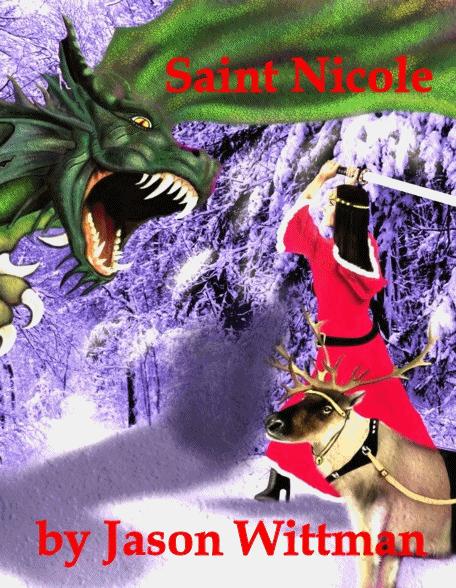
Santa's Daughter as Dragon Slayer: Jason D. Wittman's SAINT NICOLE


I'm delighted to welcome fellow Alban Lake Publishing author, Jason D. Wittman, who promises to give some insight into his highly original fantasy novel, Saint Nicole. Christmas in July, anyone?

*   *   *
Twisting the Roots of Christmas 
by Jason D. Wittman

When Anne invited me to discuss my novella Saint Nicole on her blog, I was not sure what to write at first.  Most writers grow uncomfortable when asked, "Where do you get the ideas for your stories?"
 
The reason for this is that the people who ask that question seem to expect some fascinating, eye-opening answer, like: "I was playing Nikolai Rimsky-Korsakov's Flight of the Bumblebee on my bagpipes one day, when suddenly it occurred to me..."  In reality, most sources of inspiration are depressingly ordinary.  Stephen R. Donaldson, for instance, has famously said he was once inspired by a can of Lysol disinfectant in a men's room at a convenience store.
 
Me, I get my inspirations from other sources.  One time, some co-workers and I were discussing funny t-shirts we had seen, and I told them of one that said "Schrodinger's cat is dead," on the front and "Schrodinger's cat is not dead," on the back.  My co-workers all gave me blank stares.  And as I struggled to think of a way to explain the concept of Schrodinger's cat to them, my short story The Sarcophagus of Lady Schrodinger was born.
 
The inspiration for Saint Nicole, though, did not come from a t-shirt.  It came from those newspaper articles you see whenever Christmastime rolls around that tell of how the various Christmas traditions came to be -- the Christmas tree, for instance, comes from Germany; while mistletoe was originally used in druidic rituals.  This got me pulling together a mythical "origin story" of how all these ancient traditions joined forces to become what we know now as Christmas.  And that phrase "joined forces" put me in mind of an epic conflict, where the peoples of various cultures come together to defeat a common enemy, in the vein of The Lord of the Rings.  There would be mortal human beings, of course, and joining them would be the Fair Folk, as well as the Thunder People, vaguely representing the Norse, and the Lightning People, representing the Greeks.  I also put in a mysterious figure called the Silent Knight, and the Five Golden Rings, powerful magic talsimans inspired by The Lord of the Rings and the old song "The Twelve Days of Christmas."
 
Santa Claus, or St. Nicholas, would have to be involved, of course.  Eventually, I got the idea of there not being one, but generations of them, each inheriting the role from his father when the time came.  And this inspired a further twist: what if a Nicholas died without any male heir?  What if he only had a daughter?  And so our heroine Nicole was born, who finds herself assuming her father's mantle when he is killed by his ancient archenemy...
 
Archenemy.  Let's see now.  What kind of archenemy would be appropriate for this story?  Well, since Christmas is all about the bestowing of gifts, and of Peace on Earth, Good Will to All, it seemed to me that the story's main antagonist would have to be the most sociopathic, solipsistic creature ever born.  And so I came up with the dragon Furnaceheart, whose one single goal in existence is to eat everything and everyone in existence.  Throughout the entire novella, he cannot understand why all this yummy food does not want to be eaten.  Don't they understand that's what food is for?  I wrote an entire chapter of the novella from Furnaceheart's point of view, and it was extremely fun to write an interior monologue with that kind of mindset. I like to think I got it right.
 

In the end, it falls to the young, inexperienced Nicole to defeat this vile foe.  If you want to know how she fares, you will have to read the novella itself.

*   *   *
Learn more about Jason D. Wittman on his blog.

Purchase Saint Nicole from Alban Lake Publishing.


Thursday, July 16, 2015

Save the Funny #Scifi. Pre-Order Alternate Hilarities: Weirder Science #AltHilKS4


If you know my work, you know I love funny.

And now I've gotten myself involved (embroiled?) in another funny project. Strange Musings Press is publishing Alternate Hilarities: Weirder Science, the fourth volume in a series that pays tribute to a previous sci-fi periodical of the same name, from back in the day when magazines existed only as bound paper objects.

I'm very pleased that my space mining caper, "The Motherlode," will be included in this new anthology. And now's your chance to pre-order through Kickstarter:

https://www.kickstarter.com/projects/809941908/alternate-hilarities-weirder-sceince

Here's some info from the series editor, Giovanni Valentino:

Science can be both savior and damnation. The inventions of the great minds of the world can make our lives easier, bring about our destruction and facilitate the delivery of terabits worth of funny cat videos. Technically, those last two might be the same thing.
Here is a collection of humorous tales of science like the perils of time travel, how body switching can both help and hurt the gender gap, the woes of the classic Mad Scientist in a modern world and the importance of pizza throughout the universe.
So grab your guide and towel. Get ready to brave the dangerous terrain of theory and hypothesis.

Madness and Science go hand and hand.
Skipping, Singing and Laughing Maniacally!
Muahahaha!


Seriously...don't you simply need to read this?

Friday, July 3, 2015

Column series: Examining different types of #Kidlit - On @EatSleepWriting


I'm starting to feel like an old hand at this weekly column-writing gig. The way my brain functions, I can get nearly anything done if I think of it as a series of tasks and schedule those tasks in some sort of regular pattern. Seems to be working for my Kid Lit Insider column on Eat Sleep Write.

If you haven't seen it yet, please check out my latest four-column series, taking a close look at writing for various age levels in the kidlit market. To read the columns, simply click on the titles:

What is Middle Grade literature?

What is YA literature?

What is Early Reader literature?

What is New Adult literature?


Thursday, June 18, 2015

Diana Reep Uses Spanish-American War as Backdrop for #YAlit novel


Fact is, we haven't had enough YA historical fiction on this blog. Diana Reep is here to fix that, sharing some background about her novel, The Dangerous Summer of Jesse Turner. Hold onto your hats: we're in for some rough riding.

*   *   *

Teddy Roosevelt’s Volunteers
By Diana Reep

I appreciate the chance to talk about my teen historical adventure, The Dangerous Summer of Jesse Turner. I prefer to write fiction based on action-packed exploits in the past. The Spanish-American War of 1898, although brief, certainly fit that requirement and also was crucial in creating an independent Cuba. My research partner and I were discussing the 1890s in general when we realized the war was a perfect setting for a teen adventure.

President McKinley sent the regular U.S. Army to Cuba, but the First U.S. Volunteer Cavalry Regiment formed by Lt. Col. Theodore Roosevelt captured the attention of the public. Volunteers for the Rough Riders, as the regiment was called, came from across the nation—cowboys, students from Yale and Harvard, farmers, and Indians from the western territories.  The challenge in historical fiction is to create vivid characters who live their own lives within the framework of historical events. 

The diversity of Rough Rider volunteers made it easy to develop three teens from different backgrounds who find friendship and loyal comrades amid sudden bloody conflict. Choosing the teen to narrate the story was also easy. Jesse Turner is from a small town in the Missouri area where the famous outlaws Frank and Jesse James and the Younger brothers once lived. Attaching his family background to the outlaw history means he has to face a personal enemy among his fellow Rough Riders along with the deadly hazards of combat. His pals, New Yorker Will and Ben, a Comanche from the territories, share his dangers and struggle with their own personal tests.

The fun in research for me is finding stories that lie beneath the general surface record.  For instance, although the volunteers were called Rough Riders, they had to leave most of their horses behind in Florida because the decrepit merchant ships taking them to Cuba were overloaded with troops. Of the horses that did sail to Cuba, most drowned in attempting to land on the beaches. So, the Rough Riders walked through the jungle and fought on foot. Battles often get the most attention in history books, but just as important were the daily frustrations the volunteers had to face—ugly land crabs, heat, rotten food, fever, torrential rains, and constant wet feet.

Readers who like fast-paced action-adventure will find it in The Dangerous Summer of Jesse Turner. As a writer I hated to leave Jesse, Will, and Ben, and they remain my favorite characters.  

Blurb:  When sixteen-year-old Jesse Turner lies about his age and joins Colonel Theodore Roosevelt’s Rough Riders, he expects to prove himself in battle. What he doesn’t expect is a fellow volunteer determined to kill him for something his outlaw father did in the past. Jesse and his new friends, New Yorker Will and Ben, a Comanche from the Indian Territories, share the hazards of a volunteer military force unprepared for war and the reality of deadly combat. Facing dangers from all sides, the three teens depend on friendship, courage, and integrity to get them through the bloody action of the Spanish-American War.

*   *   *
Purchase The Dangerous Summer of Jesse Turner at Barnes and Noble and Amazon

Learn more about Diana Reep here. 

Monday, June 8, 2015

Exploring #Picturebook #selfpub on @EatSleepWriting


Over on Eat Sleep Write, I've now got two columns under my belt. Pop on over if you're interested.

Self-Publishing Your Picture Book 1: Kindle Kids' Book Creator

Self-Publishing Your Picture Book 2: Alternatives to Kindle

I'm having a fun time so far, and learning a lot as I go. Let me know what you think, and also if there are certain topics you'd like me to cover.


Friday, May 22, 2015

Heckuva week: A new #kidlit blogging gig and 3 story sales!


It's been a crazy few days. And I mean crazy in a good way (for once). Here's the scoop:


1. I've been named the first-ever Children's Lit columnist for a wonderful website called Eat Sleep Write.

2. Dreaming Robot Press will publish my middle-grade sci-fi story "Leafheart" in the 2016 Young Explorer's Adventure Guide. I'm especially pleased about this, both because I was also in the 2015 edition, and because the folks at Dreaming Robot are outspoken advocates of diversity in kidlit.

3. Urban Fantasy Magazine will publish my weird, funny tale called "The Duchess of Fitzrovia," which I wrote a couple of years ago during a trip to London.

4. Strange Musings Press will publish my story "Motherlode" in the anthology Alternate Hilarities 2: Weirder Science. If you're a fan of my Webrid books, you'll enjoy the style of this space mining caper.

Items 2 and 3 are made especially sweet because both were revisions requested by the respective editors. This maintains a stat of which I am exceptionally proud: I have a 100% acceptance rate on stories I've been asked to revise. That's a darn good skill to have in this biz.


Thursday, May 14, 2015

Gender-bending for the love of science in Catherine Haustein's NATURAL ATTRACTION


My guest today is Catherine Haustein, author of Natural Attraction, a science-based historical romance. She shares her book's complex background.

*   *   *
Science, Sexuality, and Classification
by Catherine Haustein

I’ve been a chemist for over thirty years and it’s a stimulating and often amusing career—in other words, good novel material. Like Clementine in Natural Attraction, I’ve frequently imagined that things would have gone more smoothly had I been a man. Setting Natural Attraction in a time of strict gender roles illustrates how far we’ve come and what still needs to be done.

I chose to place Natural Attraction in 1871 because it was a time of great social change. The theory of evolution and the discovery of sperm and egg cells were quietly ushering in ideas of social equality. Science was a train riding the rails of certainty and classification. And in the hometown of my ancestors, Singapore, Michigan, USA, ecological disaster was brewing. These coalesce in Natural Attraction.

Picking the best genre for the story was a challenge. I decided to write it as romance, not sci-fi. My family was involved in a Shakespeare Festival for a while and I appreciated the complexity of the comedies and the required happy ending, fitting with a romance. Science is filled with passion, curiosity, and the unknown just like romance and the two are very compatible. I also thought it would be fun to give a scientist a romantic liaison with a preacher to let them explore what they had in common.

Another challenge was giving Natural Attraction a Victorian feel without being weighed down by flowery language. I had Clementine be from a family of recent immigrants from the Netherlands, as my ancestors were. I had some characters use Victorian idiomatic expressions. I enjoyed incorporating a Victorian melodrama and theater into the manuscript and included patent medicines and the use of poisonous dyes in clothing as important Victorian touches.

One aspect I wrestled with was how to address sexuality and the transformation of Clementine into a man. I work in a male dominated field and had an inkling of the isolation she might feel as a woman who didn’t really fit in anywhere. I had help from men, particularly those at the Iowa Writers’ Workshop, who offered suggestions on what it takes to be a man and the privilege and culpability that come with masculinity. This book is a romance pitched towards women but the comic look at gender roles should appeal to everyone who’s ever felt stuck in them.

Blurb: Clementine dreams of being a naturalist—a career that leaves no time for romance. To sneak on an adventurous prospecting expedition, Clementine will have to convince everyone she’s a man. A mysterious tonic offers her just that disguise.
But “Calvin,” as she calls herself now, had no idea what she was giving up. When Wesley, the expedition’s gentle preacher, catches her eye, she can’t get him out of her head; not his lush lips, wide brown eyes…or broad chest. Dare she reveal her secret to him? Can she keep her career if she does?

*   *   * 
Natural Attraction is available from Penner Publishing, Lybrary, and other major booksellers.

Find the author at catherinehaustein.com and on Facebook