Thursday, October 13, 2011

Guest blogger: Author Jane Richardson

I'm delighted to welcome Jane Richardson, author of the humorous urban romance story Edinburgh Fog, recently published by MuseItUp. Jane has offered to tell us about her process in writing dialog that both sounds authentically Scottish but is comprehensible to everybody.

*   *   *

Writing The Scots I Know

Thank you so much, Anne for letting me visit your blog today! For your readers who don't know me, my name is Jane Richardson and I live in the south-east of England.  I write contemporary stories with a delicious dollop of romance in them, and let me see, what else?  Oh, yes, there's one more thing - I'm Scottish.

Why did I hesitate, you ask?  What's wrong with being Scottish??  Well, nothing of course!!  Except maybe....well, look. Let me explain.

My latest publication is a story called Edinburgh Fog.  It's a story I almost didn't submit.  Why?  Because I'm aware that when the words 'Scottish' and 'romance' are used in the same sentence, certain expectations are - shall we say! - aroused. 

There’s an enormous market for 'Scottish romance,' particularly with the Highlander-type stories - they're hugely popular.  In recent years I've also seen a move towards more contemporary Scottish stories, very often with an American heroine and Scottish hero, or vice versa.  Nothing wrong with that at all, I know many people adore them, and I've written a novel myself in the past with an American hero and UK heroine.  There's something about that old 'special relationship' between Britain and the UK that carries beautifully into romance stories.  We are two nations divided by a common language, and it seems we love noting better than making that division just a little smaller, while still highlighting our wonderful differences.  That's great with me!

When it comes to me being Scottish, however, that often raises another issue - the way we Scots actually speak.  There does seem to be a generally accepted Scottish-romance-speak, and it's very genre-specific.  Again, there's nothing wrong with that.  Readers know what they like, and I'm full of admiration for authors who are savvy enough to give readers exactly what they want.  But the way the characters in those novels speak is not how I speak at all.  All the characters but one in Edinburgh Fog are Scots, and so naturally, they speak with Scottish accents.  That's where my difficulties began!  Do I write in this universally-accepted Scottish romantic fiction language, or do I stay true to myself and write what I'm familiar with and know to be true, while still keeping as much Scottish flavour as I could?

Well, of course, dear reader, I went with what I know.  I could have 'translated' my characters' speech into 'book Scottish' - instead I tried to keep the flow and the rhythm of the way Edinburgh people speak, without using too many dialect words or trying to write out an accent.  The key is to try and make the speech as understandable as possible while still keeping it Scottish.  I personally don't like it when I have to slow down my reading speed just to try and make sense of what a character is saying, and I'm sure I'm not alone.  That has to be the major consideration for any writer who's thinking about employing dialect or characters' accents in their writing - first and foremost, the reader has to understand it.

Here's an example from Edinburgh Fog - Ben Hardie is a big, tough, beer-swilling, rugby-playing, typical Edinburgh lad.  Here he is expressing his disgust at the male companion of a couple of women Ben's got his eye on.

“Look at him! Manky wee ginger git, and he’s got those gorgeous babes with him. What’s he got that I haven’t?”

Now, if I'd written Ben in storybook-Scottish, he might have sounded a little more like this:  

"Tak' a gaunder at him, manky wee ginger git, and they gorgeous babes wi' him. Whit’s he goat that I hivnae?"

I don't know about you, but I find the second example pretty hard to read - and I wrote it!  The first example is of course the one you’ll find in Edinburgh Fog.  Does Ben sound any less Scottish in that example?  I don't think so.  The inclusion of just a few understandable dialect words - 'manky wee ginger git' - helps to underline Ben's Scottish-ness without rendering him unintelligible. 

Here's another longer example of three of the main characters in conversation.

"It’s frickin’ freezing out there. Frickin’ Edinburgh.” Ben’s muffled voice emerged from the coils of the scarf wound around his chin. “Freezing fog everywhere, ice all over the pavements. They’ve stopped the buses going down Hanover Street in case they can’t stop and tip right into Princes Street Gardens. I had to walk in to work. Did it warm me up? Did it heckuzlike. Slid all the way, fell over three times and dented more than my pride, I’ll tell you that for nothing. I’m no’ taking anything off till I thaw out.” His shivering, grateful hands took the coffee from Greg. “Thanks, boss. Feels like it’s been winter forever.”
Greg laughed. “I thought you rugby players were tough. Out in all weathers, rain or shine.”
“That’s merely a myth we perpetuate to make us look macho. Only a certified headcase would get down to his shorts in this weather.”
“Wimp,” Chrissie called from the other end of the bar.
“Oh, aye, right,” Ben retorted, “coming from someone who got a taxi to work. I saw you going past like Lady Muck. You might have given me a lift.”
Chrissie grinned, screwing the pourer into the top of a new bottle of vodka. “Don’t take your coat off yet, big man. I need a crate of bitter lemon up from the cellar, and if you think it’s cold outside, you wait till you get down there. It’d freeze the funny-shaped balls off a rugby team.”
Ben and Greg exchanged looks. “Do you actually employ her for real money,” Ben asked, “or was she a free gift with the beer delivery?”
Greg laughed. “Nothing but the top staff for Tellers’.”
Here it's the rhythm of the speech that marks them out as Edinburgh natives.  I hope you'll agree that exchange doesn't make them sound any less Scottish than they actually are! 
But of course, it's more than just the way characters speak, isn't it?  I hope in Edinburgh Fog, I've managed to convey everything I love about a city that was my home for many years; not only the people and the wonderful, idiosyncratic way they speak, but also their wit and humour - and of course, beautiful, extraordinary Edinburgh itself. 

*   *   *
Edinburgh Fog is available in all e-book formats from MuseItUp Publishing. Click here.

You can visit Jane Richardson at her blog, Home Is Where the Heart Is.


Tuesday, October 4, 2011

Help me, Sir Arthur Conan Doyle!

I decided to start working again on a middle grade mystery novel I'd shelved 18 months ago because I got involved with other projects.

Today I printed out the four drafted chapters and the projected synopsis I'd written for the other twelve chapters, and took the bundle over to a coffee shop to read while I had a muffin. As I paged through, the prose was looking pretty decent, or at least salvageable, but I couldn't for the life of me remember the story. So, with great curiosity, I skimmed the synopsis.

When I got to the description of chapter 9, I laughed out loud and choked on my muffin. It said, "Something must happen to give them a clue. WHAT??? And how would they know?" And the last sentence was in red ink: "This plot ain't working."

And that's my ninth chapter! Weirdly, there's a lot of detail for chapters 10-16. But I've got a hole in the middle of my mystery, apparently. Do you plot around problems and sort them out later?

Thursday, September 29, 2011

Guest blogger: MG author C.K. Volnek

GhostDog_Cover200x300.jpgWe have a special guest today! C.K. Volnek's new novel, Ghost Dog of Roanoke Island, combines the historical and the paranormal. I asked her to talk about her research process.

*  *  *

Thanks for allowing me to visit your blog today, Anne.

Ghost Dog of Roanoke Island is a tween ghost story, with a twist of Native American folklore, and based on a true American mystery…the Lost Colony of Roanoke Island. In 1587, 117 colonists disappeared from Roanoke Island without a trace.

I don’t remember studying the Lost Colony. For years I thought the first colonists landed at Plymouth. After reading an article on the mystery of Roanoke Island, my muse perked up. What could have happened to them? I had to know the when, where, why and how it all happened. I had to research.

Some may groan. Research means reading, studying, examining facts. I used to hate history. I was awful at it. I could never remember or keep all those dates straight. And besides, what did history have to do with today?

Now I have found research interesting, fascinating, captivating. I can get lost in the past’s events. And I’ve found history has everything to do with today. Every situation has a cause and effect theory. What we do today, can and will determine what happens tomorrow.

As in my research for Ghost Dog of Roanoke Island, I found I had to go back a few years before the Lost Colony to understand the full story. Cause and effect…If Queen Elizabeth had not granted Sir Walter Raleigh a charter for the colonization of the land she called ‘Virginia,’ none of this would have happened. If

But it did. In 1584, Sir Walter Raleigh dispatched two men to explore the Eastern coast of North America. It proved fruitful and a second expedition with a hundred men was sent out, headed by Sir Richard Grenville. The men built a fort and a number of small houses but soon abandoned their adventure. Grenville, however, left a very hideous crime behind. In his exploration, a group of Native Americans had been invited on board one of the ships. A silver cup came up missing and the Indians were blamed. Grenville sent his men to destroy the entire village of Aquascogoc.

Despite the mystery of the Lost Colony, without this crucial piece of history, my story of Ghost Dog of Roanoke Island would never have been born. I was so appalled at the intolerance and prejudice my muse grabbed hold of the details and formulated her story. It drove my muse to research even more, even searching to find original manifest of the colonists, digging up pictures and facts of early colonial and Native American life, and details as to why Governor White, after going back to England for supplies, returned to Roanoke Island three years later to find a deserted fort and no clues to the whereabouts of the colonists.

My muse then turned to research the flora and fauna of Roanoke Island. A writer must know details of the area to make the story enchanting and believable. I studied what plants grew in the area, what the terrain looked like, and the layout of the island.

Once I pulled all my research together, added my characters, and threw in a ghost and Native American folklore, the plot of Ghost Dog of Roanoke Island became visible. A story, emphasizing how the pain of intolerance and prejudice affects people, flowed from my fingers.

I hope you’ll check out Ghost Dog of Roanoke Island and find out how research built my tale. Even though my story includes a ghost, the history of the Lost Colony of Roanoke Island is first-most present and factual.

Thanks again for letting me visit your blog. It’s been fun. I’d love to hear from your readers.


*  *  *

You can visit C.K. Volnek at her website
and purchase Ghost Dog of Roanoke Island here.

Thursday, September 22, 2011

Guest blogger: YA horror author Araminta Star Matthews

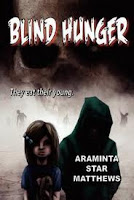
Kids save the world from their undead parents! This mind-blowing premise is the idea behind Araminta Star Matthew's YA novel Blind Hunger. I'm delighted to have her as my guest today. I asked her to talk about character development in her work.

*  *  *

First off, let me thank Anne for asking me to be a guest blogger. Thanks, Anne!   My writing process for Blind Hunger played out very differently than it has for other novels and short stories I’ve written. First off, the story was originally a NaNoWriMo (National Novel Writing Month) winner a few years back, so I whipped the original draft out in just thirty days. It took another two months to finish the first draft, then a full year of editing before I felt it was tidy enough to submit to a publisher. Normally, my process is very different: I write and plan as I go, adding details and revising/refining my words for months at a time, then allowing my manuscript to sit for a while collecting dust before I start on it again.
                You asked how I’m able to write compelling and believable characters, and thanks for that. That’s quite a compliment. I think that’s about the one place my training as a classic literary novelist comes into play. I have both an undergraduate and graduate degree in creative writing which prepares you to write the next Gatsby, not the next Carrie, if you know what I mean. While I wouldn’t say Blind Hunger is very literary (that is, a story driven by characters and not plot), I would argue that my characters certainly benefited from all that classic training. As a result, they’re three-dimensional with unique personalities. I owe this to an insatiable curiosity and study in psychology and sociology: you have to know what makes a person tick (or what might make a person tick) in order to write that person in a believable way. For example, I’ve never been a teenage boy with abusive parents—far from it; my parents were mostly loving and supportive. So, to create the characters for this novel, I actually drew on my theatrical background—a skill riddled with psychology and sociology--to bring them to life. I literally would sit at my computer and tense up my shoulders, or start gasping for breath, trying to find the right way—the angle—in which my individual characters would react to a given moment.
Their idiosyncrasies required a little more research. I spent time with some local teenagers, asked questions of my students (I teach college writing) about what kind of music the Emo or Goth kids listened to when they were still in high school, and I watched a lot of film and television adaptations of youth culture. Then, when I was sitting at the keyboard entering their personalities into the ether of my hard drive, I would add to my list of theatrical actions whatever I gleaned from that study. Then I was punching away at my keyboard with black nail polish on, or I was playing with this chemistry set my mother got me for my birthday (yes—she still buys me children’s toys, and I love it). It was a good time.
Acting out scenes and characters was kind of a reverse literature lesson for me. In a literature class, I would task my students with pulling out what was important in a scene or amidst a stack of character dialogue in order to write little scripts to play out in class. In this sense, I flipped it. I now acted out scenes before I wrote them down. It allowed me to achieve stronger sensory details if I was, for instance, tensing my own shoulders or gasping in the way my characters were; and, it also helped me to identify what really mattered—that is, what I really needed to show in a given scene.

*  *  *            
                                                                                                                                 
  You can visit Araminta Star Matthews here.  Buy Blind Hunger at Amazon and elsewhere.


Thursday, September 15, 2011

Global Blog Tag: 10 Random Facts about Anne E. Johnson

Have you ever played a GLOBAL game of tag?
Well, I'm It.
I've been tagged by children's author Miranda Paul.

Rules (if you're tagged): You must be tagged by someone; list 10 random facts about yourself; tag four more people.
Ready or not, here I go!


1. I've been teaching music history and music theory for 15 years.


2. In 1984, my mother made me a birthday cake in the shape of K-9, Doctor Who's robot dog. This picture of it was published in the Whovian Times.


3. My father is a journalist. I think that's why I can write so fast.


4. I'm a pretty good tap dancer.


5. Although I never rode in an airplane until I was 16, as a child I traveled all across the U.S. on car trips with my family.


6. I'm married to a playwright, Ken Munch. A lot of writing goes on at our house!


7. In college I majored in Ancient Greek and Latin. It's one of the best decisions I've ever made. There's no better way to get to know how language works and how it developed.


8. When my mother was in the Peace Corps, I got to visit her in Morocco. 


9. In July of 2012 I will have lived in New York City for 20 years.


10. Because I've lived in NYC for so long, a trip to a suburban shopping mall is an exciting and exotic experience for me.


And I tag the following four unsuspecting writers:


1. Debra Brenegan
2. Gueh Yanting Claudine
3. Roseanne Dowell
4. Cat DeLallo


You're it!
And everyone else: tell me one thing about you!

Thursday, September 8, 2011

Guest blogger: Suspense author S.L. Pierce

Please give a warm welcome to S.L. Pierce, who knows how to make you sit on the edge of your seat and jump at a plot twist.  Her new novel is The Devil's Game. I asked her to discuss how she fills her writing with suspense. 

*  *  *

What makes a good thriller?  I thought I might answer that today with an example.

1)  The noise was coming from the bedroom.  But that was impossible.  No one else was home.

2)  It was faint.  Just the slightest creak.  But it was enough to pull her from a deep sleep.  Out of habit she got up to check the baby, but stopped herself short.  Michael was gone.  Forever.  And the house was empty.  Wasn't it?  

Do you find yourself drawn in by number two more than number one?  Why is the baby gone?  Who is in the house? 

There are two things that make a good thriller (in my opinion).  The first, of course, is making the reader curious.  But just the right amount of curious.  You have to give them little crumbs; just enough to keep them interested but not so much they figure out the mystery too soon and lose interest.  It's a fine line and a good writer has to find that balance. 

Second, and more important, is making the reader care about the character(s).  You can write the most edge of your seat, nail biting, thrilling story and yes, that will get people to start reading, but if they don't care about the character, they won't keep reading.  Look at the example above.  Aren't you just a little more curious about the second example?  Aren't you a little more invested? 

Not convinced?  It really hits home with me when I think of one of the bestselling and prolific writers out there today.  I'm sure you know who I mean.  I used to love his books, but for the last few years I haven't been able to read them.  Why?  Because he hasn't made me care about the characters.  His story plots are great – fast and fun.  But the characters are flat.  Boring.  Unrealistic.  And I just don't care about them. 

Thriller readers, think about that the next time you read the first few pages or download a sample.  What makes you keep reading and what makes you put the book down or delete the sample without buying.  I'll bet it's lacking one if the items mentioned above. 

Writers, look at your opening; can you make the reader invest a little more in the story with just a few extra words?  Take a few sentences and give it a try.

*  *  *
You can visit S.L. Pierce at her blog.

Wednesday, September 7, 2011

Buy links for Greek Myths Revisited

Greek Myths Revisited, an anthology published by Wicked East Press, is now available. It contains my story "Table Manners," a sci fi re-telling of the bloody, crazy myth of Tantalus, which is all about how jealous the gods get when men are too proud and ungrateful.

You can buy it from Pill Hill Press Shoppe

or from Amazon

(This is definitely not for children!)